
Public Art Sydney: A Fabricator’s Guide to Sculpture & Installations
Sydney's public art tells two stories. There's the one you see—bronze figures, polished steel, ceramic murals catching the afternoon light. Then there's the one you don't. The engineering. The problem-solving. The midnight calculations about wind loads and galvanic corrosion.
We're fabricators. We've spent years translating artists' visions into structures that can survive a Sydney summer, a southerly buster, and a few million passing commuters. So when we walk through the city, we read public art differently—we see the engineering behind it. This guide covers the most significant public art in Sydney's CBD. The works featured here were created by a range of artists and built by various fabrication studios across the industry—not by Di Emme. What we're offering is a fabricator's perspective on what it took to make each one stand up: the materials, the loads, and the problems someone had to solve along the way.
Featured in this guide:
And more
Public Art at Martin Place and 1 Elizabeth Street
The Metro development has delivered the most ambitious public art program Sydney has seen in decades. These aren't decorations. They're engineered installations built to handle millions of footfalls, constant vibration, and the unique challenges of underground infrastructure.
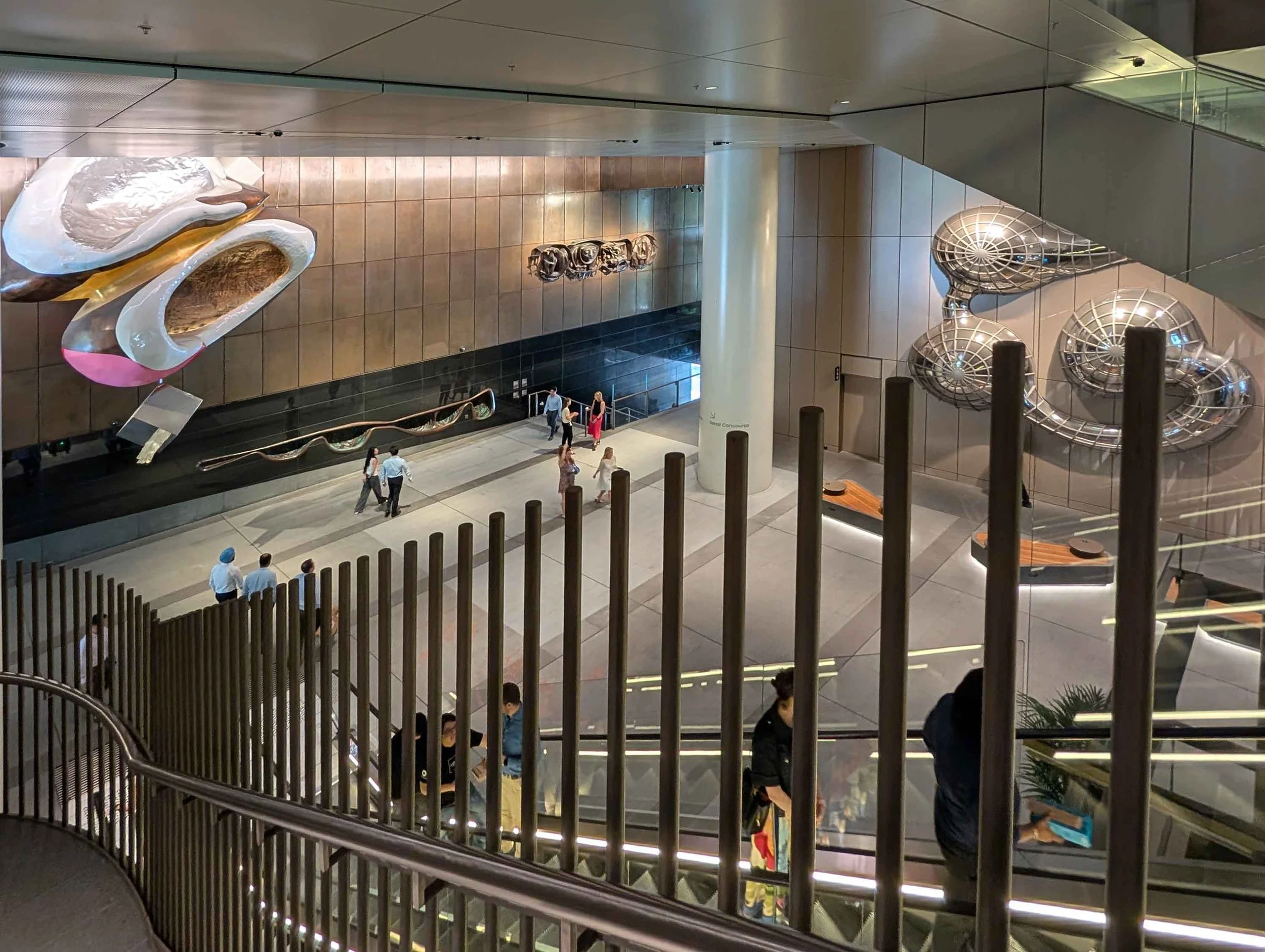
A view inside the 1 Elizabeth Street precinct, featuring the suspended forms of Mikala Dwyer’s Shelter of Hollows (left) and the undulating stainless steel of The Magic Circle (right)
Continuum — Mikala Dwyer (2024)
Location: Sydney Metro Martin Place Station
Structural engineering & certification: Event Engineering
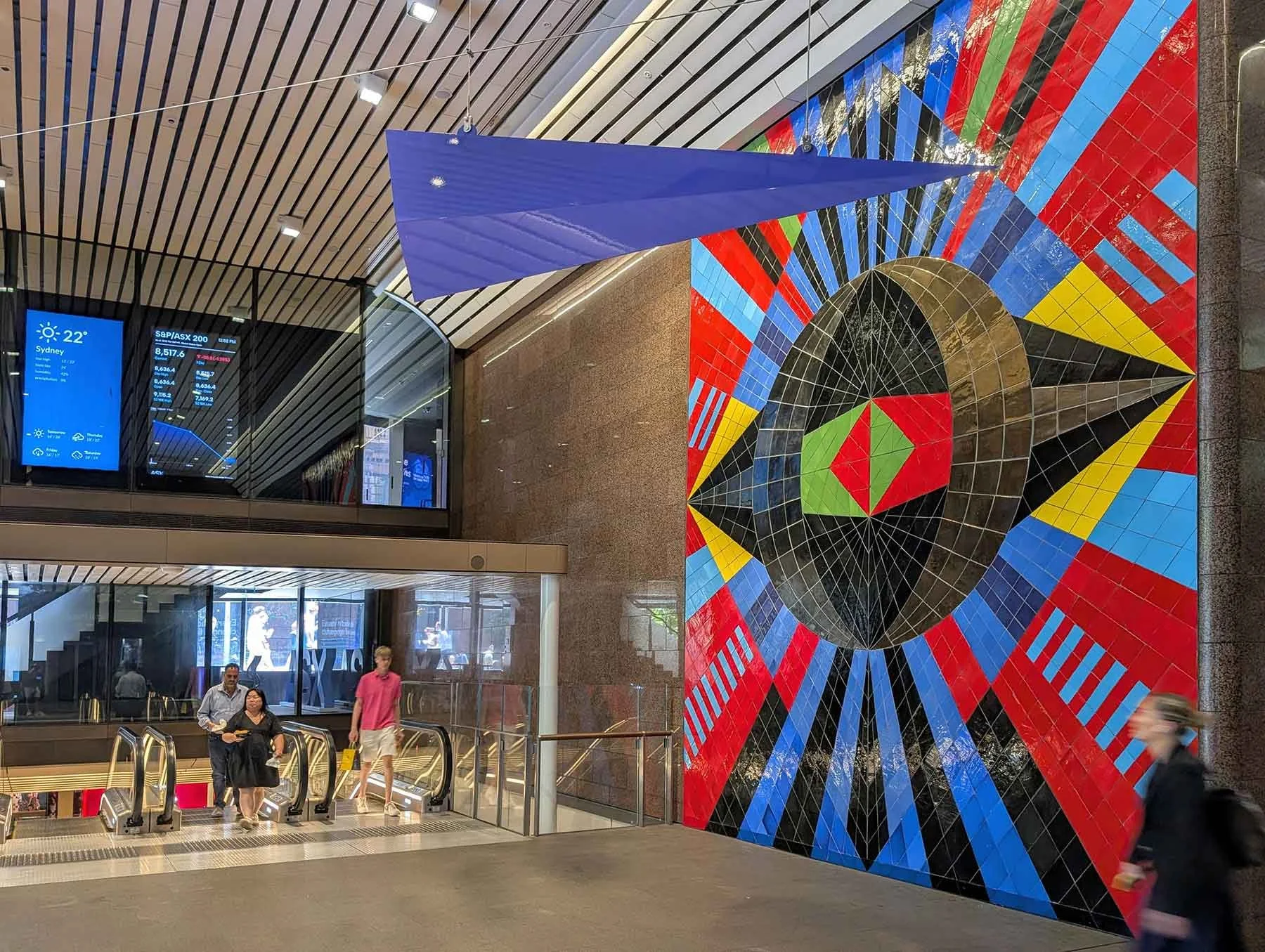
Mikala Dwyer’s massive glazed ceramic mural at the Martin Place Metro (South Entrance)
Walk through Martin Place station and you'll encounter Dwyer's split vision. At the South Entrance, a sweeping ceramic mural abstracts the rhythm of train travel. At the North Entrance, a suspended Möbius strip rotates overhead—a mathematical loop representing Sydney's endless flow of commuters.
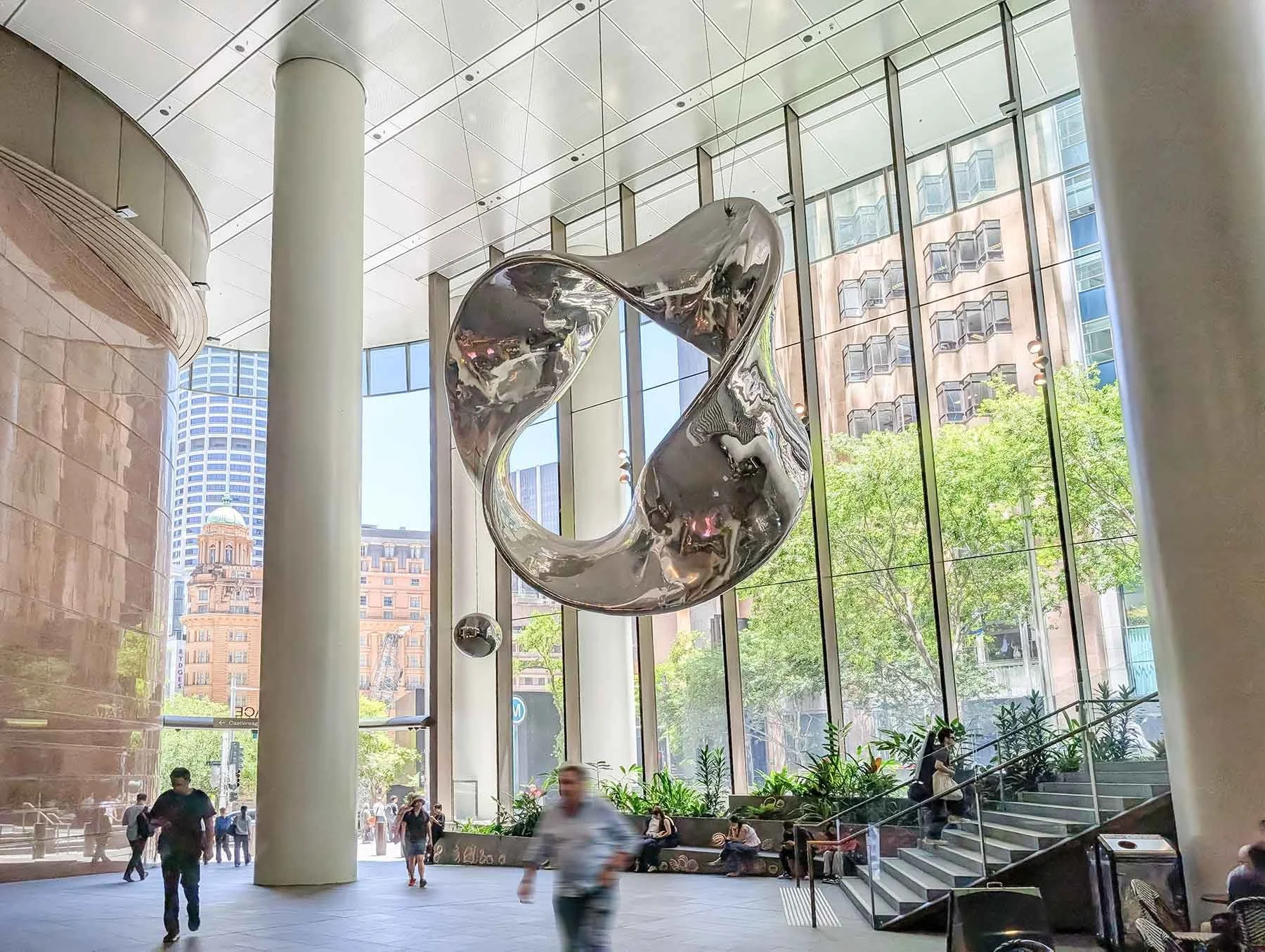
A view of the suspended Möbius strip. Note the sphere visible in the background—part of the wider collection of "suspended prisms" that required careful galvanic isolation to hang safely alongside the stainless steel.
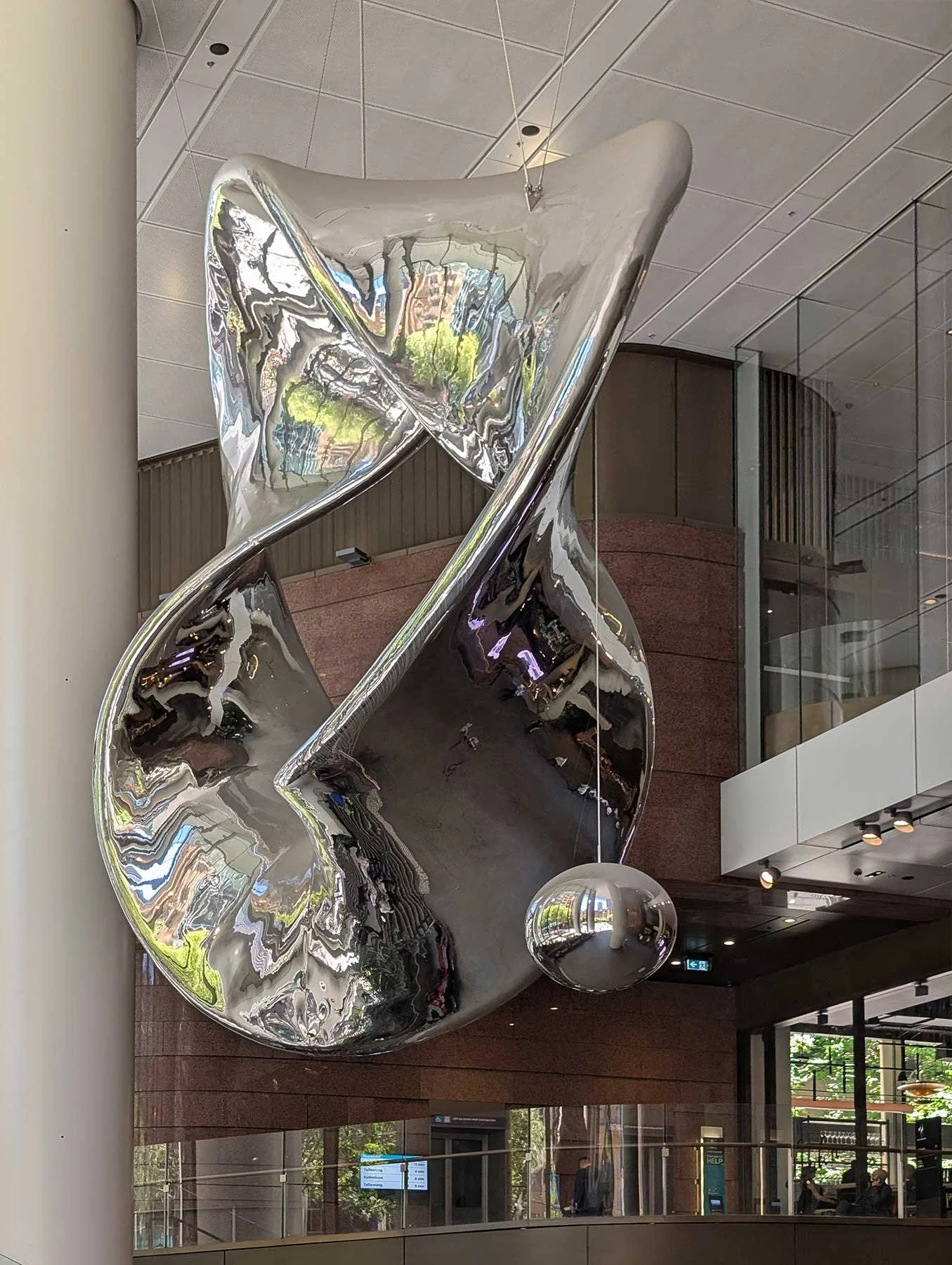
The mirror-polished finish of the 6.4-metre sculpture dematerializes its mass, reflecting the changing light and movement of the Martin Place atrium
The fabrication challenge: This project required two completely different skill sets working in parallel.
The Möbius strip measures 6.4 by 2 metres. Achieving a seamless loop at that scale meant rolling polished stainless steel into compound curves. Every welding seam had to be ground to a mirror finish. The goal was to make tonnes of steel look weightless.
The ceramic mural presented a different problem. It sits directly above an operational railway. Constant vibration would crack conventional adhesives within months. Engineers developed a specialized mounting system that absorbs micro-movements without compromising the bond.
Then there's the suspended prisms. Bronze, brass, and aluminium hang together in the same installation. These metals don't play nice. Without careful isolation engineering, galvanic corrosion would eat through the connections. Every joint required physical separation between dissimilar metals.
Shelter of Hollows — Mikala Dwyer (2024)
Location: 1 Elizabeth Street (through-site link)
Structural engineering & certification: Event Engineering
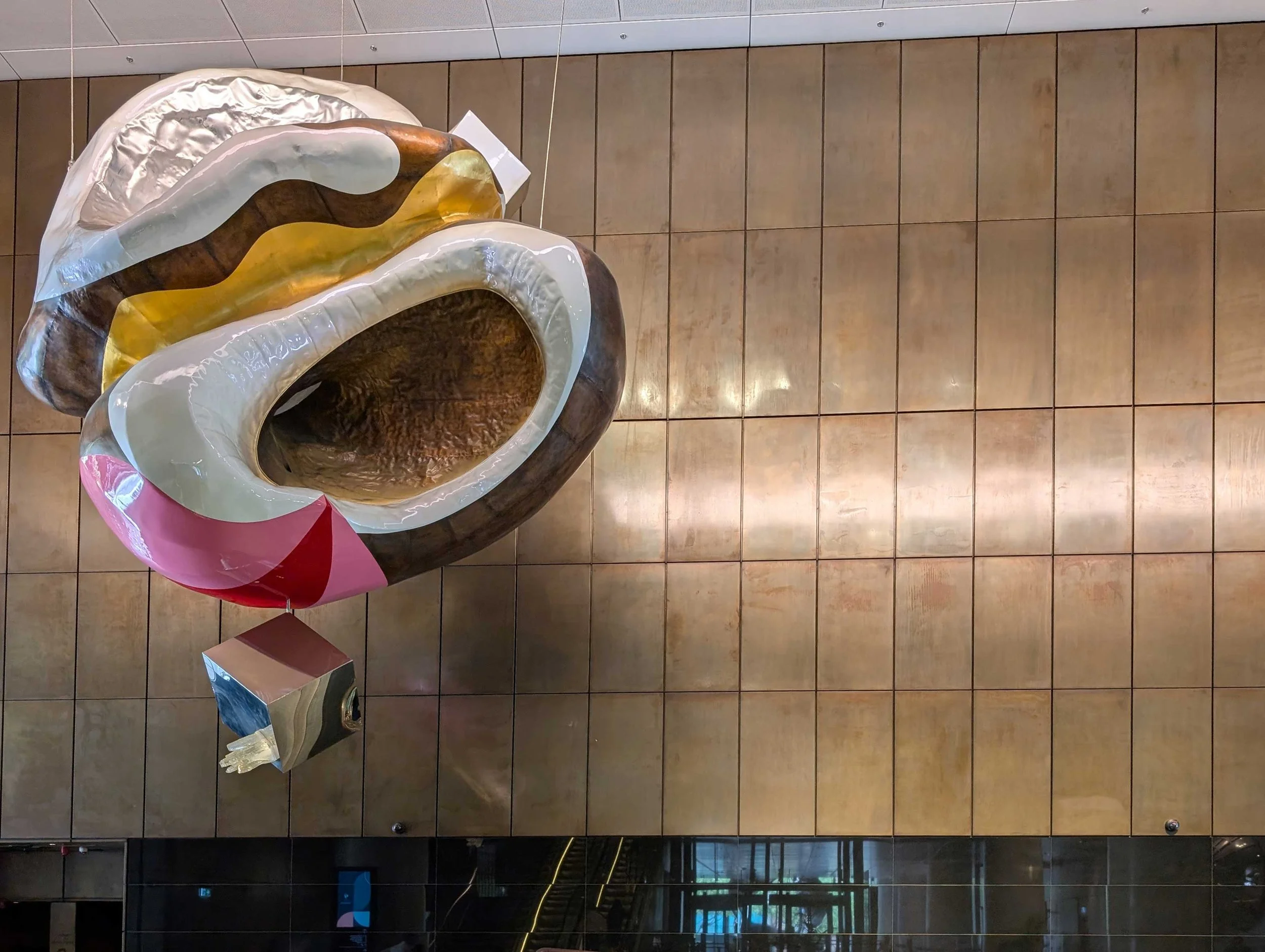
Mikala Dwyer’s "excavated" form floats against the precision bronze-toned cladding of the 1 Elizabeth Street lobby. The high-gloss interior finish is designed to catch reflections from the street below.
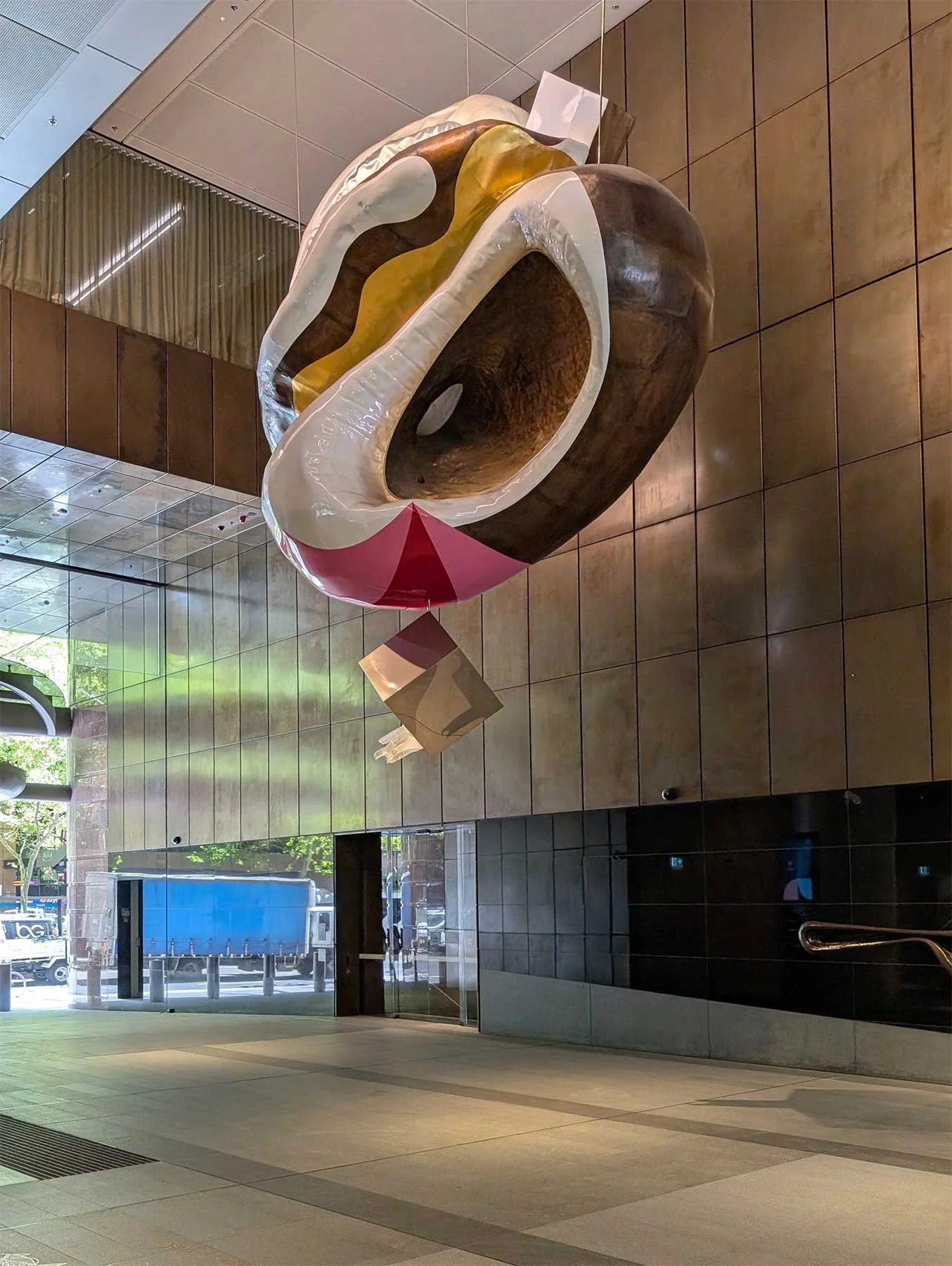
A wider view looking towards the street entrance. This angle reveals how the sculpture activates the double-height volume, utilizing natural light from the entryway to highlight the high-gloss finish against the matte bronze walls
These irregular, cave-like forms hover above the pedestrian link at 1 Elizabeth Street. Dwyer designed them to evoke geological memory—as if chunks of ancient rock had been excavated and suspended in space.
The fabrication challenge: Asymmetrical masses don't like to hang still. The through-site link creates a wind tunnel effect. Air rushes through, and anything suspended wants to sway.
The rigging system had to be invisible but strong enough to lock these forms in place. Any visible movement would break the illusion. The solution involved tensioned cables and internal dampening that most people will never notice.
The Magic Circle — Claire Healy and Sean Cordeiro (2024)
Location: 1 Elizabeth Street
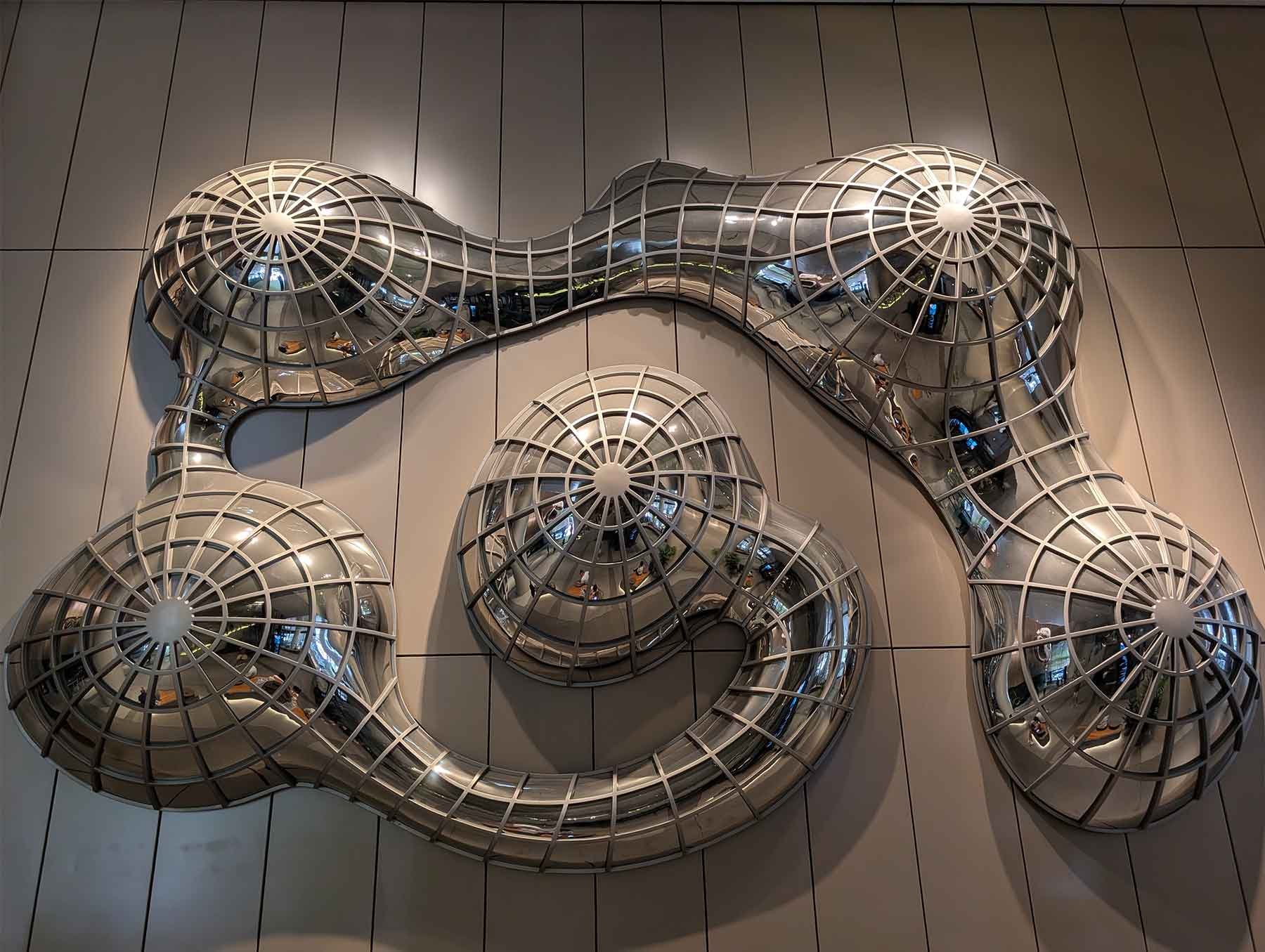
The fluid, organic forms of The Magic Circle rendered in high-grade stainless steel, contrasting with the rigid architectural grid of the 1 Elizabeth Street atrium.
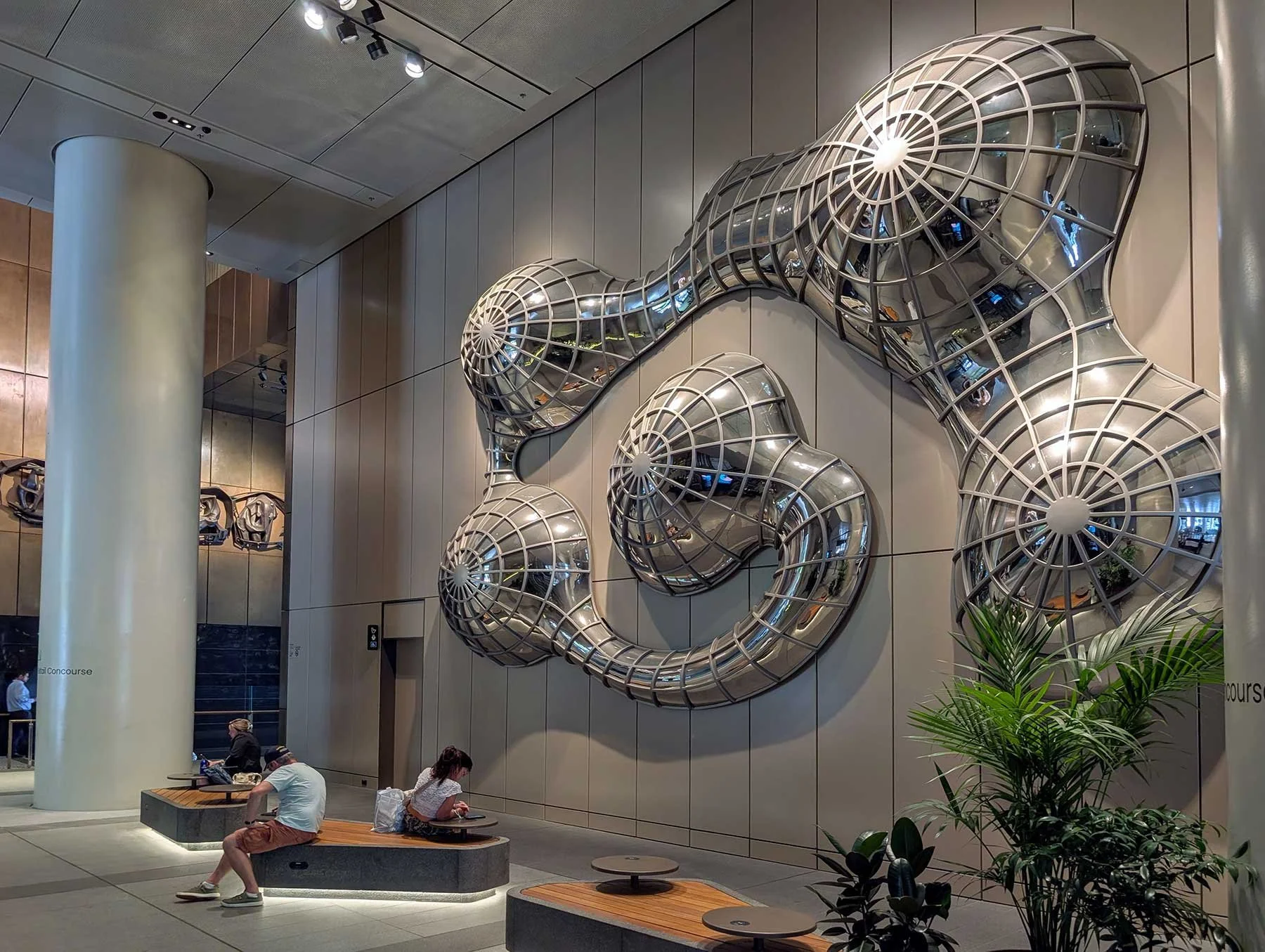
The side view highlights the "inverted skate park" aesthetic, showing how the organic stainless steel form swells outward from the flat atrium wall
Stand beneath this work and you're looking at an inverted skate park. The artists drew a deliberate analogy between urban infrastructure and an ant nest—organic forms emerging from rigid systems.
The fabrication challenge: The panels are polished stainless steel, just 2mm thick. That's about three times the thickness of a credit card. At a 9-metre span, thin metal wants to buckle. The industry calls it "oil-canning"—that wavy, distorted look you see on cheap car panels.
The solution was an internal egg-crate rib system. Hidden behind that mirror surface is a structural skeleton that maintains stiffness across the entire span. The finish had to be flawless. Any imperfection would distort the reflections of pedestrians passing below.
Tom Bass's Fountain — (1963, Restored 2024)
Location: 1 Elizabeth Street (façade)
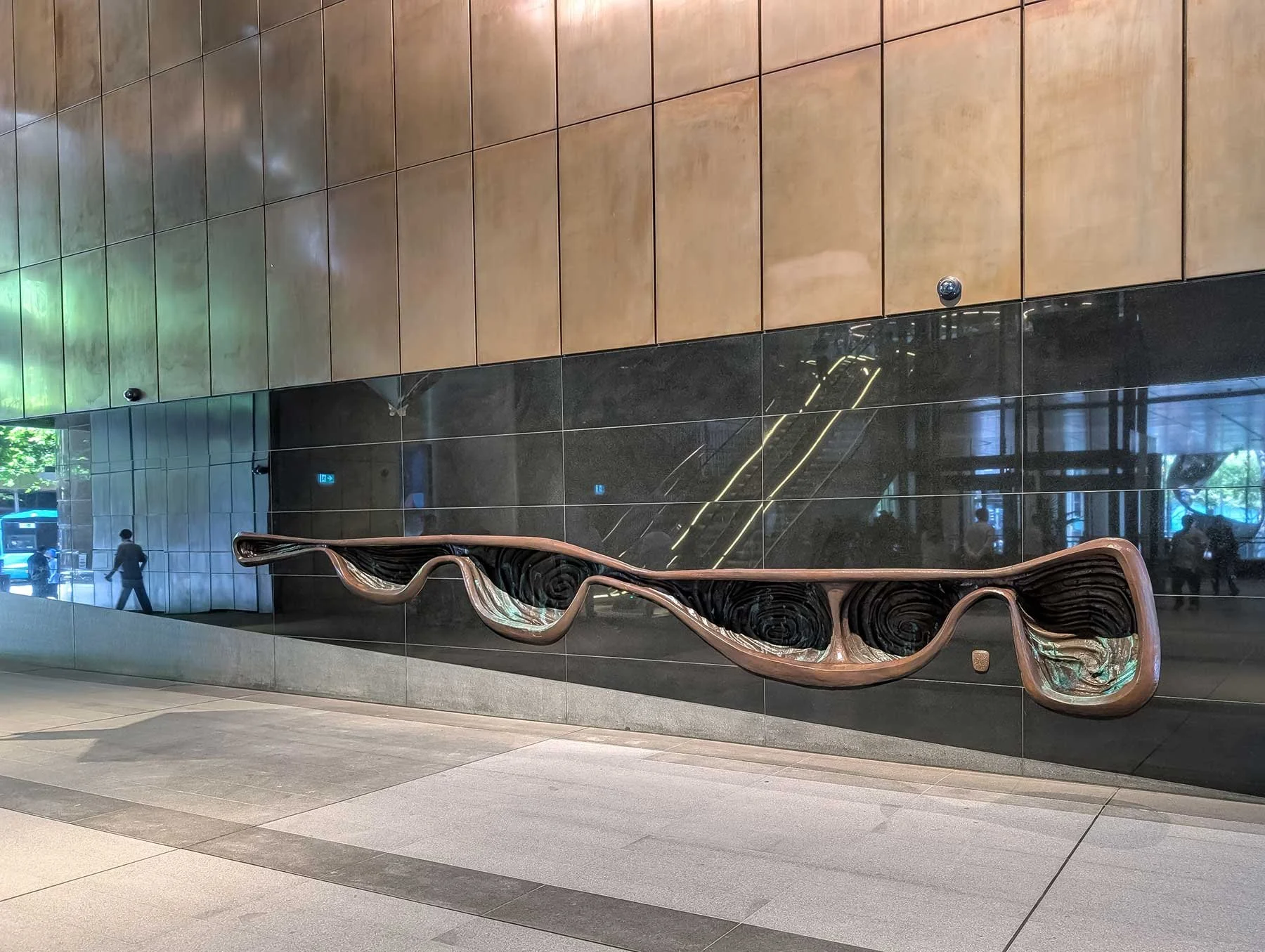
The 1963 Fountain after its 2024 conservation. Tom Bass’s organic copper form "biting into the skin" of the new 1 Elizabeth Street façade, contrasting the warm metal against the sleek dark stone cladding
This copper sculpture has bitten into Sydney's streetscape for six decades. Bass originally designed it for the P&O building, reflecting the maritime identity of its owners. When that building came down, the sculpture survived.
The fabrication challenge: Resurrection.
Bass had initially planned to work in stone. His pivot to copper accidentally saved the work—stone would have been demolished with the building. But decades of Sydney weather had taken their toll.
The conservation team used soda blasting to remove oxidation. It's a gentle abrasive method that won't damage soft copper the way sandblasting would. Then came the hydraulics. Bass had designed specific water trajectories back in the 1960s. Replicating those exact arcs required engineering a completely new pump system calibrated to his original specifications.
Douglas Annand's Ceramic Mural — (1963, Reinstated 2024)
Location: 1 Elizabeth Street (lobby)
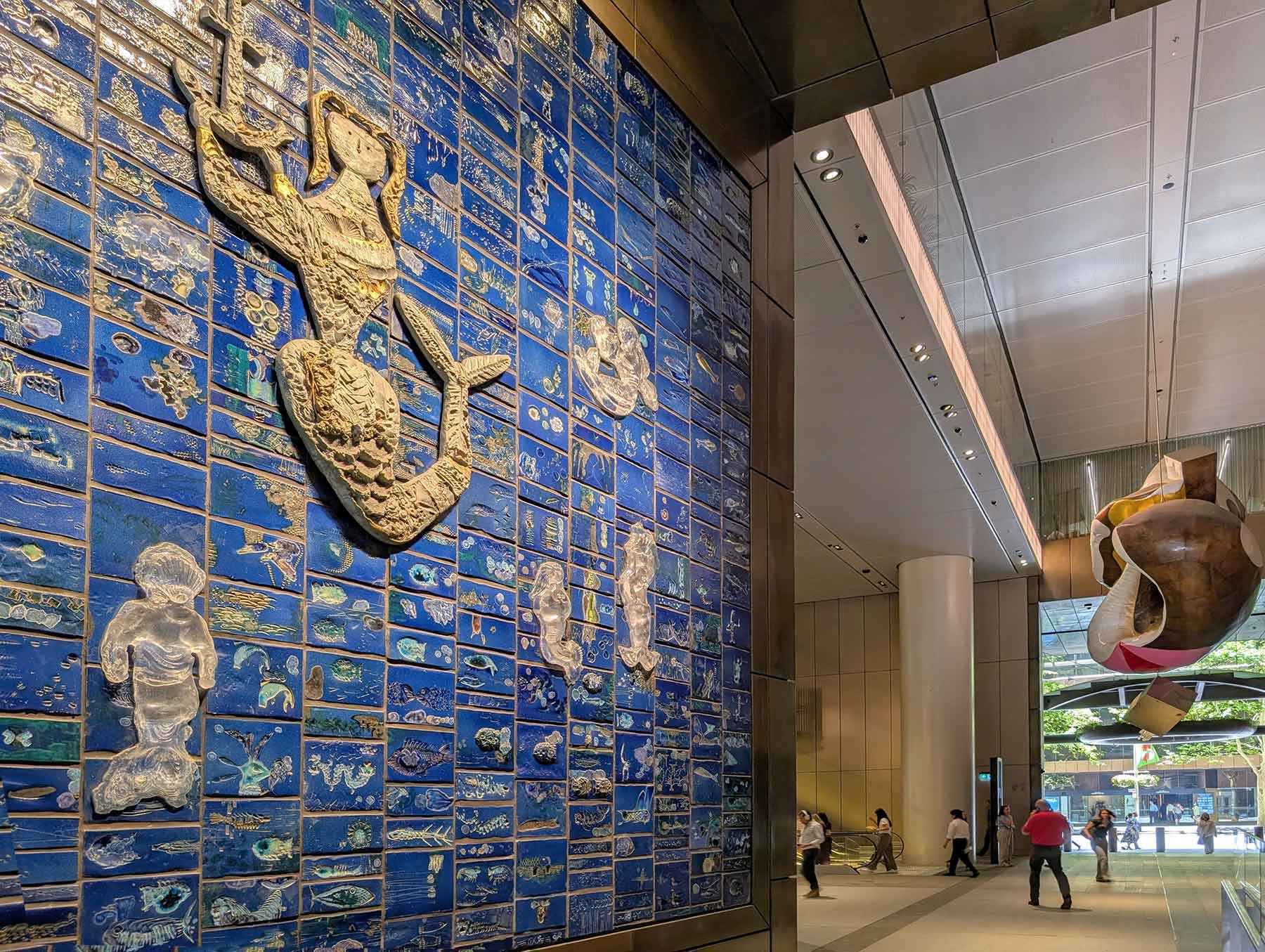
Hand-glazed 1960s ceramics meeting contemporary cast glass. Note the seamless integration of Stevie Fieldsend’s translucent figures into Annand's original grid
Annand hand-crafted 600 individual tiles for this maritime mythology scene. The restoration raised a delicate question: what do you do when parts of a heritage artwork contain culturally outdated imagery?
The fabrication challenge: The conservation team had to clean 60 years of adhesive residue without cracking vitrified ceramic. Artist Stevie Fieldsend then created contemporary glass forms to replace problematic figures. Those new elements had to match the visual weight of Annand's originals—different material, same presence.
Iconic Steel Sculptures in Sydney CBD
Before digital fabrication, before parametric modelling, there was steel, welding, and bold geometry. These works define Sydney's modernist public art legacy.
Crossed Blades — Alexander Calder (1967)
Location: Australia Square
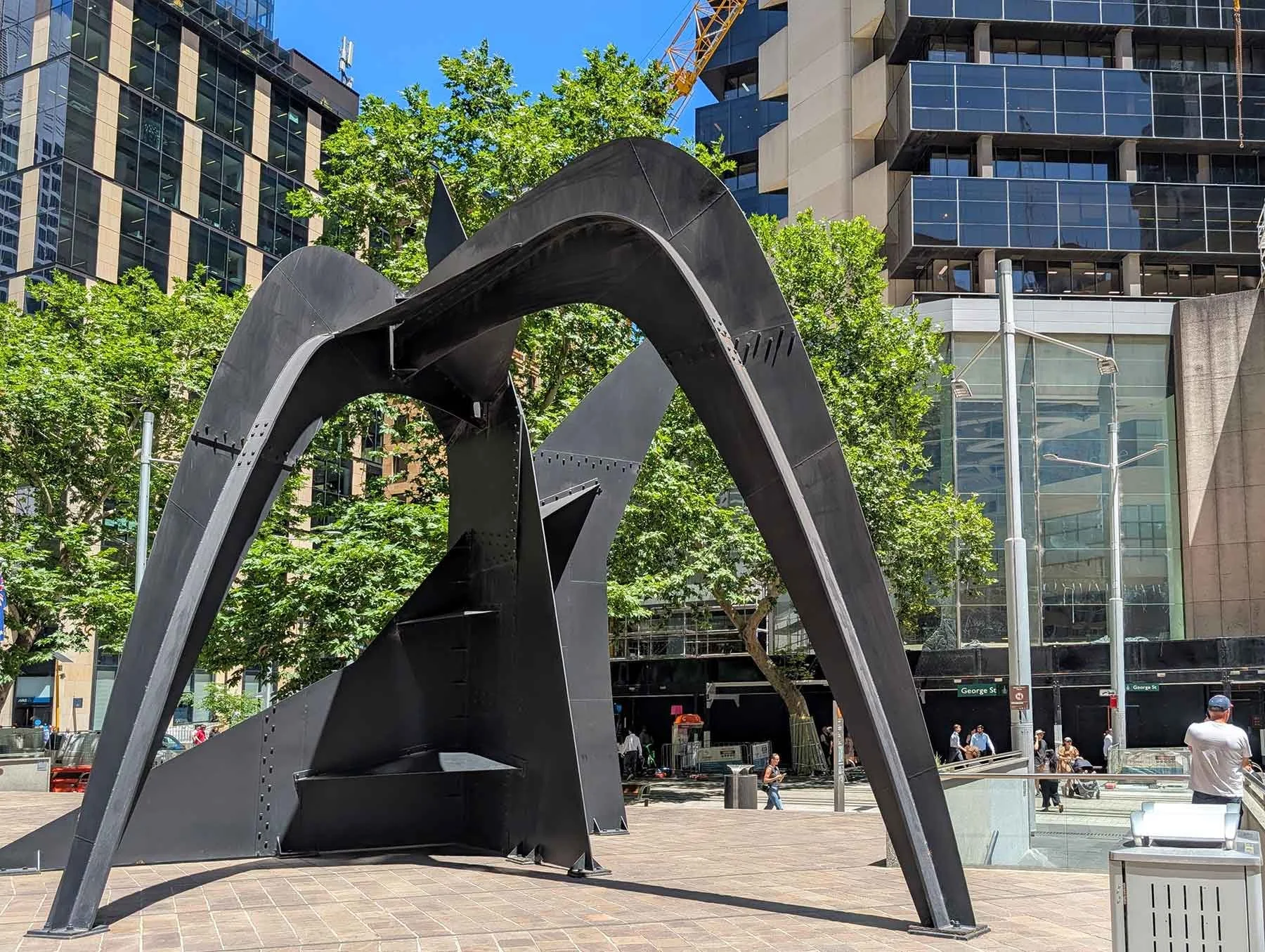
Alexander Calder’s Crossed Blades (1967) at Australia Square. This work marked the shift in Sydney’s public art from traditional bronze casting to heavy industrial steel plate construction
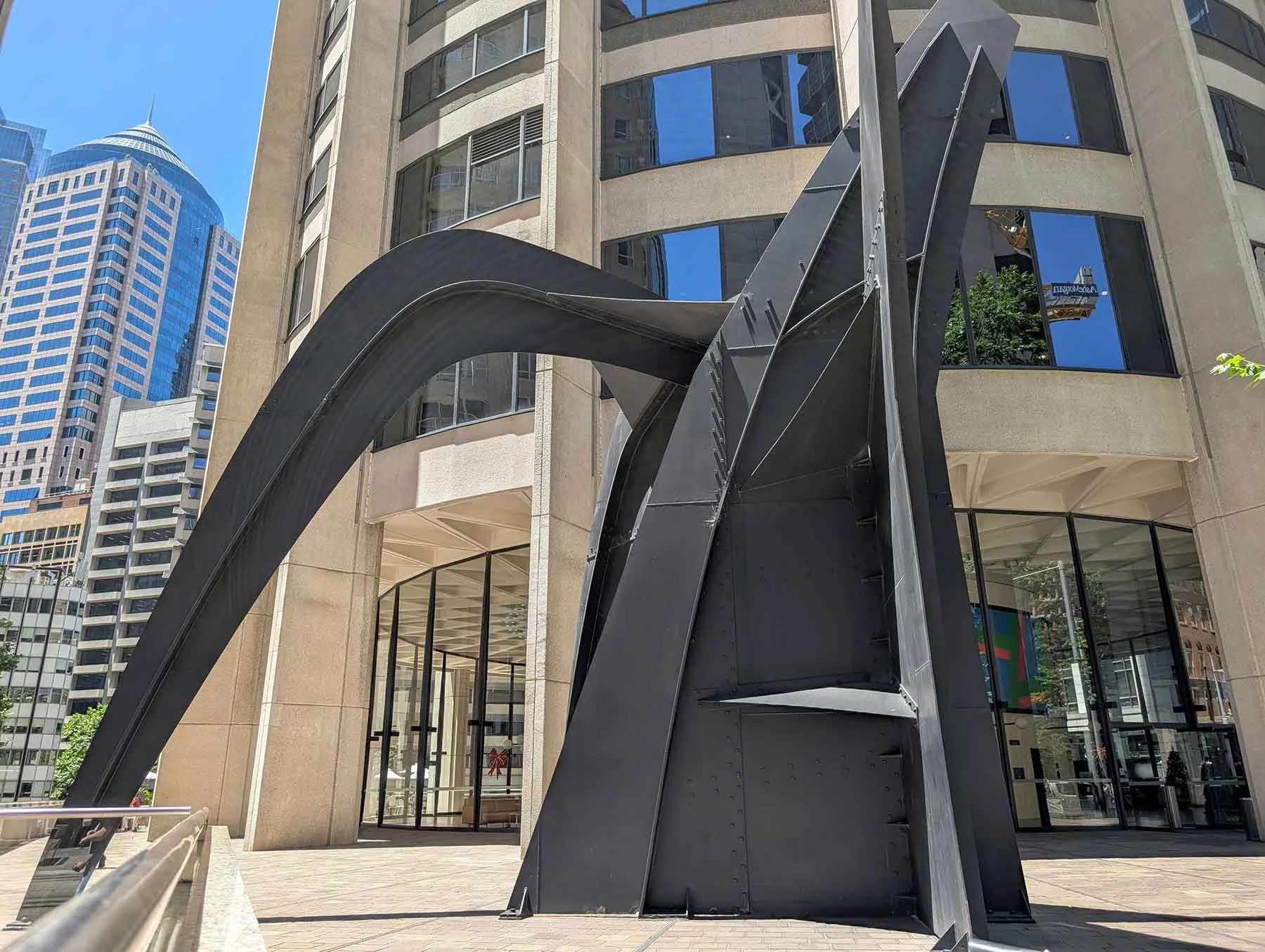
A rear view reveals the heavy-duty stiffening ribs and bolted flanges that give the sculpture its rigidity. Unlike modern welded sculptures that often hide their assembly, Calder celebrates the mechanics of construction, leaving the "skeleton" exposed as part of the visual language.
Calder's "stabile" has anchored Australia Square since the tower opened as Sydney's first skyscraper. Its striking black silhouette has become one of the most recognizable public sculptures in Sydney.
The fabrication challenge: At 11 metres high, those blades act as a sail. Every southerly pushes against several tonnes of painted steel.
The structure relies on substantial internal ribbing and deep piling foundations. Engineers had to calculate overturning moments—the force required to tip the sculpture—and design a base that could never be exceeded.
Look closely at the surface. Those visible bolt heads aren't a compromise. Calder wanted them there. They emphasize the industrial construction method. The riveted aesthetic was a deliberate artistic choice.
They Were Golden — Gillie and Marc
Location: Australia Square, 264 George St
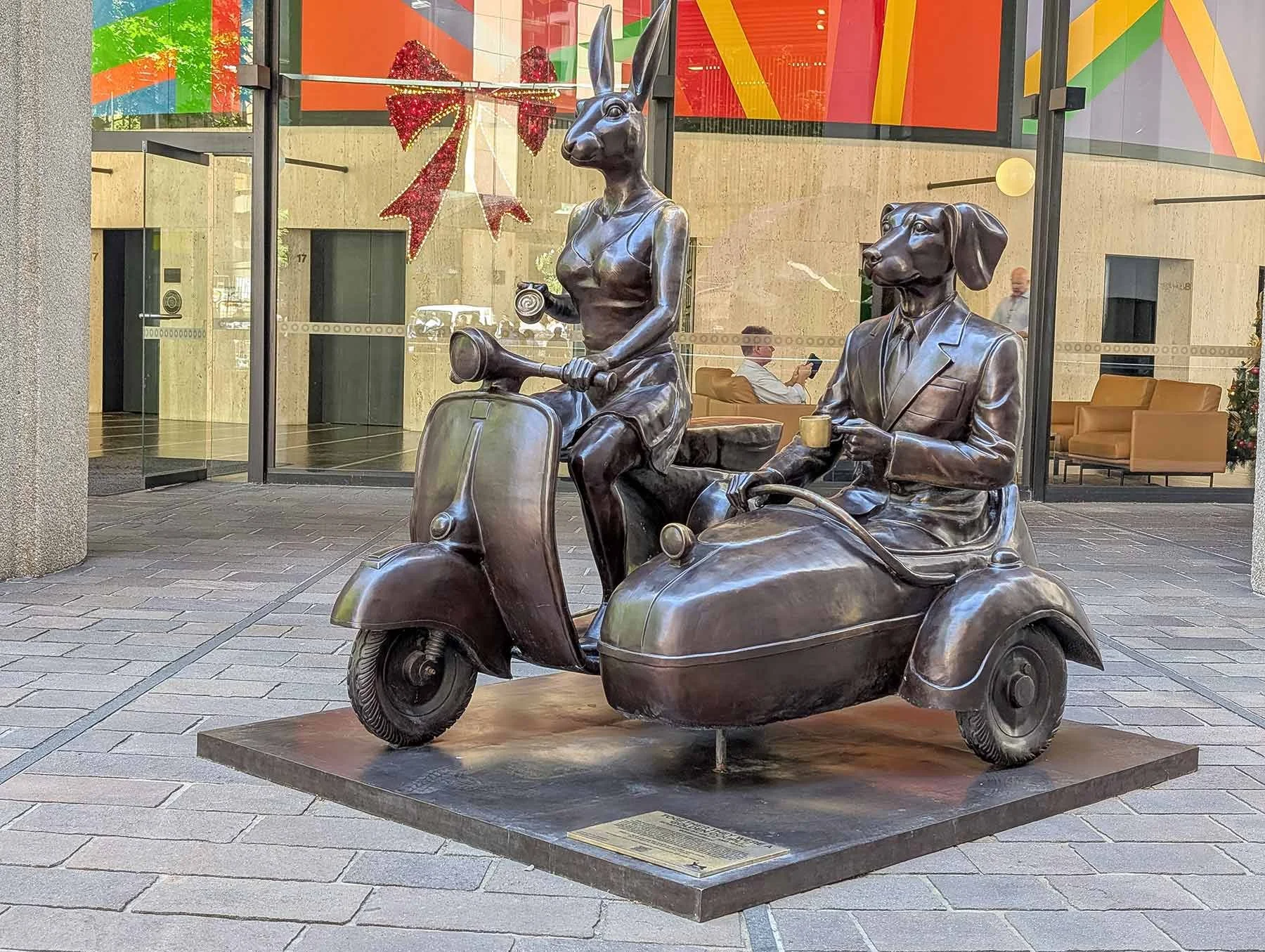
Gillie and Marc's They Were Golden. Unlike traditional "look but don't touch" statues, this bronze is designed for the public to climb on. This requires a robust fabrication approach—thicker bronze wall sections and internal steel reinforcement are essential to support the "live load" of adults sitting on the Vespa without the structure fatiguing.
A rabbit in a dress rides a Vespa. A dog in a suit sips coffee from the sidecar. It sounds like a fever dream, but Gillie and Marc's Rabbitwoman and Dogman have become some of the most recognisable public sculptures in Sydney.
The husband-and-wife team (based in Sydney's Botany) have installed their hybrid human-animal figures across the globe—from New York to Shanghai. This Australia Square piece is part of their "Travel Everywhere With Love" project. The characters represent diversity and acceptance: natural enemies in the animal kingdom, choosing companionship instead.
The sculpture is deliberately interactive. There's a seat on the back of the Vespa. You're meant to climb on.
The fabrication challenge: At 400 kilograms, this isn't a prop—it's infrastructure. The bronze has to withstand constant public interaction: people sitting, climbing, leaning, posing. Every stress point had to be engineered for repeated load cycles.
The smooth, polished finish requires meticulous chasing of all weld seams. Bronze casting at this scale typically involves multiple sections assembled after casting. The joins have to disappear completely to maintain the cartoon-like seamlessness of the figures.
There's also the patina. That rich, dark brown isn't natural oxidation—it's chemically applied and sealed. The finish has to resist Sydney's UV exposure while handling thousands of hands touching it every year. The surface treatment walks a line between durability and the warm, tactile quality that makes people want to interact with it in the first place.
Dobell Memorial (Pyramid Tower) — Bert Flugelman (1979)
Location: Spring Street
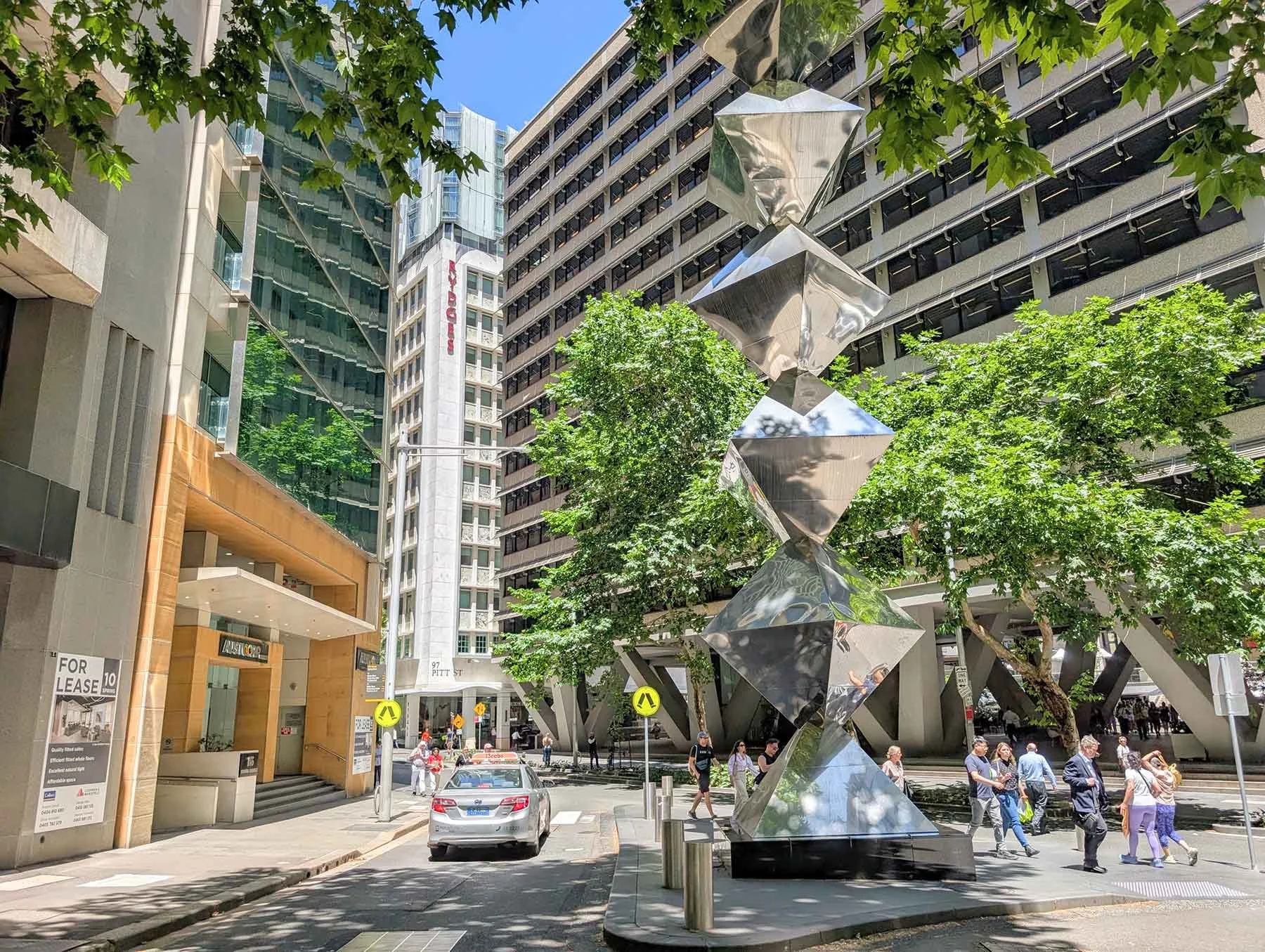
Bert Flugelman’s Dobell Memorial. The success of this piece relies on absolute "planar flatness." If the stainless steel had warped even slightly during the welding process (heat distortion), the mirror reflections would be wavy and the illusion of pure geometry would fail.
Locals call it the Silver Shish Kebab. Flugelman probably wasn't thrilled about that. His intention was to dematerialize mass—stacked polished tetrahedrons reflecting so much sky that they almost disappear.
The fabrication challenge: This is welded stainless steel at its most demanding. Every seam had to be invisible. The polishing work alone took hundreds of hours.
When the sculpture was relocated in 1999, it required completely new engineering certifications. The original design predated modern seismic codes. Engineers had to prove that a stack of balancing geometric forms wouldn't topple in an earthquake.
Day In, Day Out — James Angus (2011)
Location: 1 Bligh Street

The sculpture’s vibrant, bio-morphic shapes provide a deliberate counterpoint to the monumental white columns and rigid glass curtain wall of the 1 Bligh Street skyscraper.
This ellipsoidal form marked a shift in how public art gets made. Angus didn't sculpt a maquette and hand it to a foundry. He designed algorithmically.
The fabrication challenge: The complex geometry was born in digital modelling software. The complex geometry was born in digital modelling software, and the shapes were most likely produced using 5-axis CNC milling to create moulds for cast aluminium.
The automotive-grade paint system isn't vanity. Sydney's UV levels are brutal. Without proper protection, colours fade and surfaces degrade within years. The coating has to be industrial strength.
Public Art at Circular Quay and The Rocks
The harbour precinct carries particular weight. Any public art here sits alongside Sydney's oldest colonial structures and its most significant Indigenous sites.
Ancient Feelings — Thomas J. Price (2025)
Location: Tallawoladah Lawn, Circular Quay
Structural engineering: Partridge
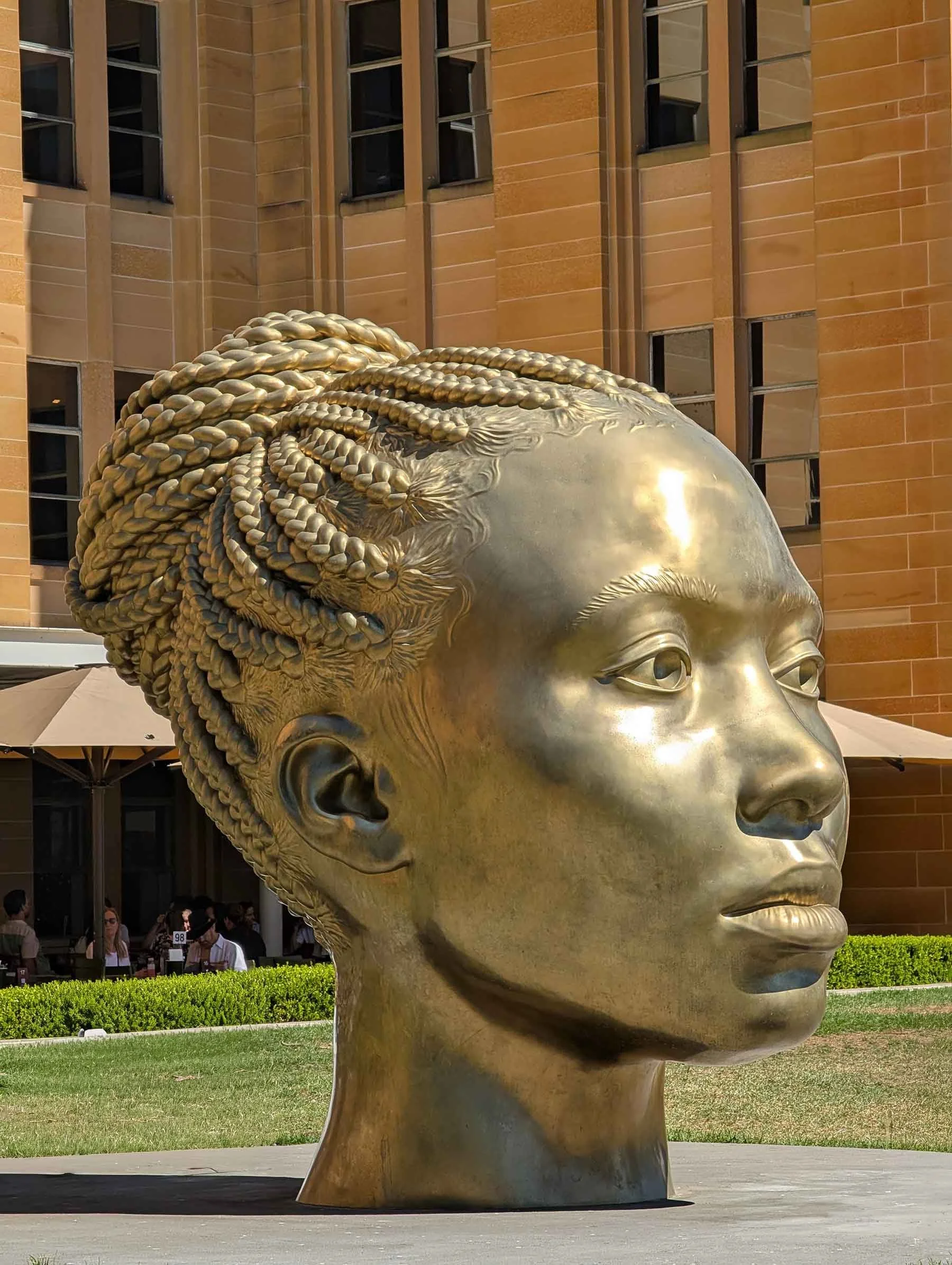
The warm, reflective golden bronze of the sculpture stands in bold contrast to the matte, heritage sandstone façade of the Museum of Contemporary Art (MCA) in the background.
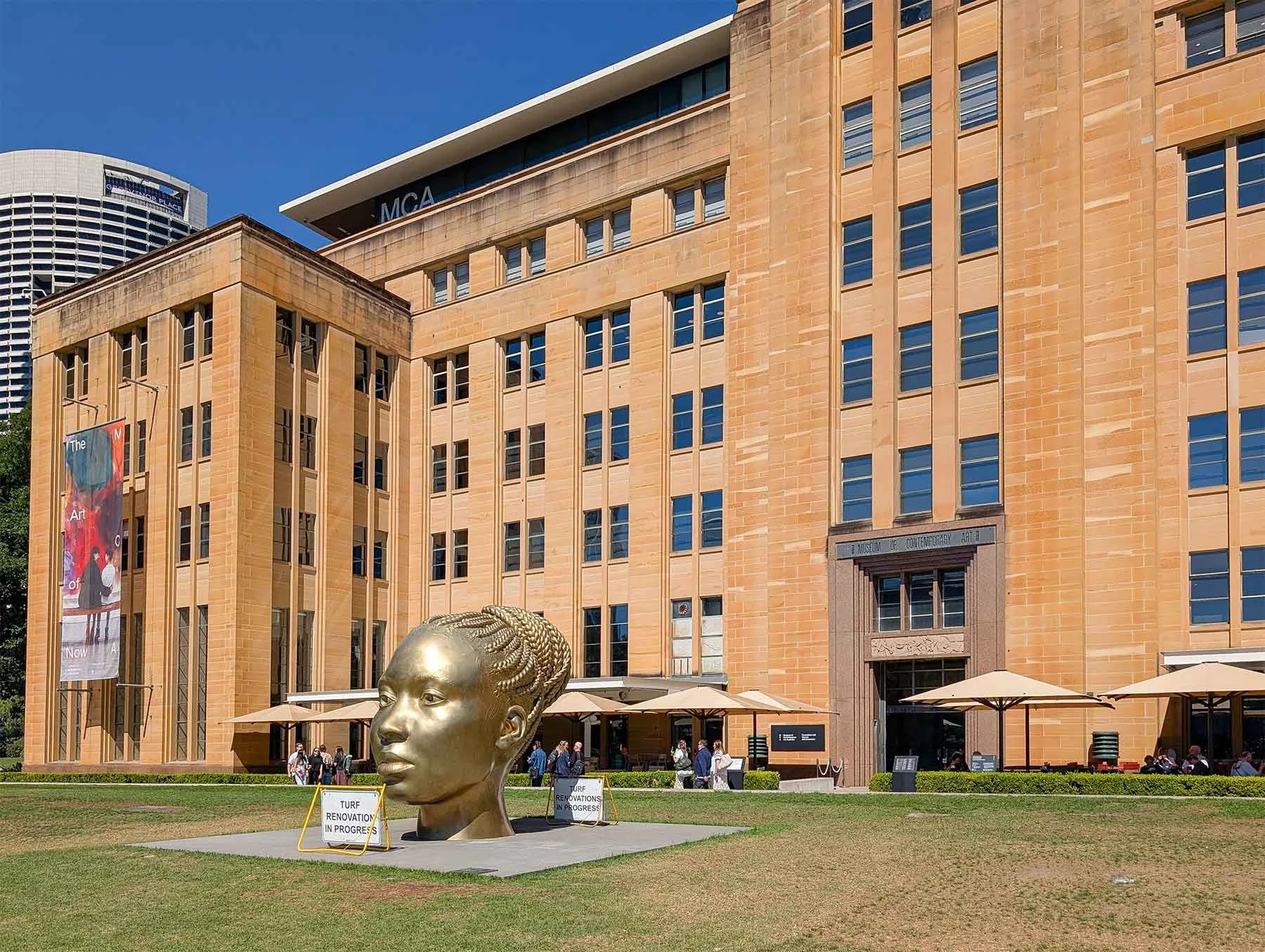
Thomas J. Price’s 3-metre tall sculpture commands the space, its reflective golden surface creating a contemporary counterpoint to the rigid, sandstone Art Deco architecture of the Museum of Contemporary Art in the background
Price's monumental bronze head depicts a fictional Black woman. It's a direct challenge to the tradition of erecting statues to powerful men. The work stands on Tallawoladah Lawn, a site with deep Indigenous significance.
The fabrication challenge: This is a temporary installation on heritage-protected ground. The engineers couldn't pour concrete footings.
The solution was a hidden steel grillage—a spreader plate system that distributes the enormous point load of the bronze across the turf. From ground level, you'd never know it was there. The sculpture uses traditional lost-wax casting. Every welding seam was chased and smoothed to create a single, uninterrupted volume.
Secret World of a Starlight Ember — Lindy Lee (2020)
Location: MCA Forecourt
Fabrication: UAP (Urban Art Projects), Shanghai workshop
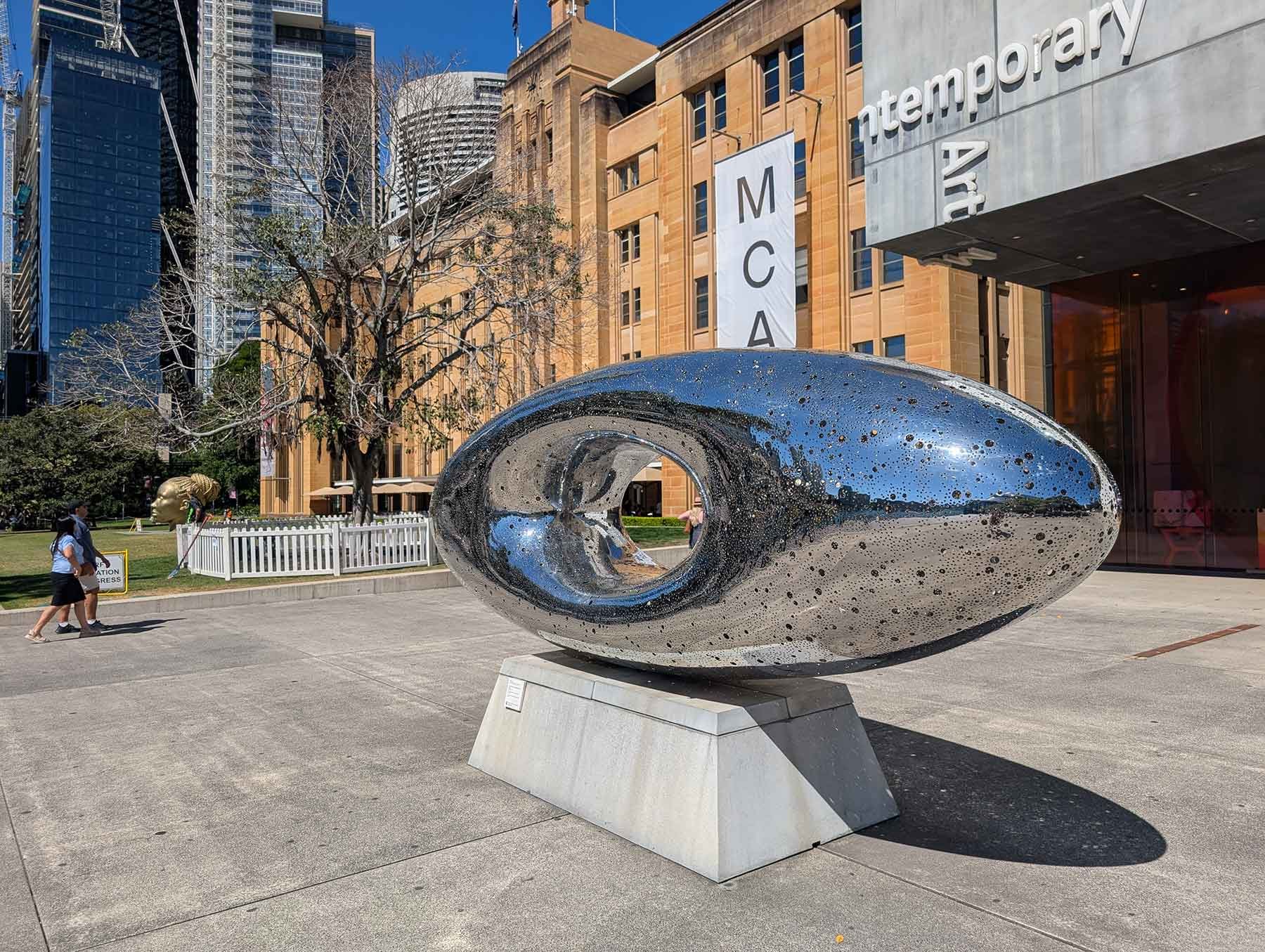
Lindy Lee’s mirror-polished ovoid stands in the forecourt, creating a striking material contrast against the warm, Art Deco sandstone façade of the Museum of Contemporary Art (MCA) directly behind it.
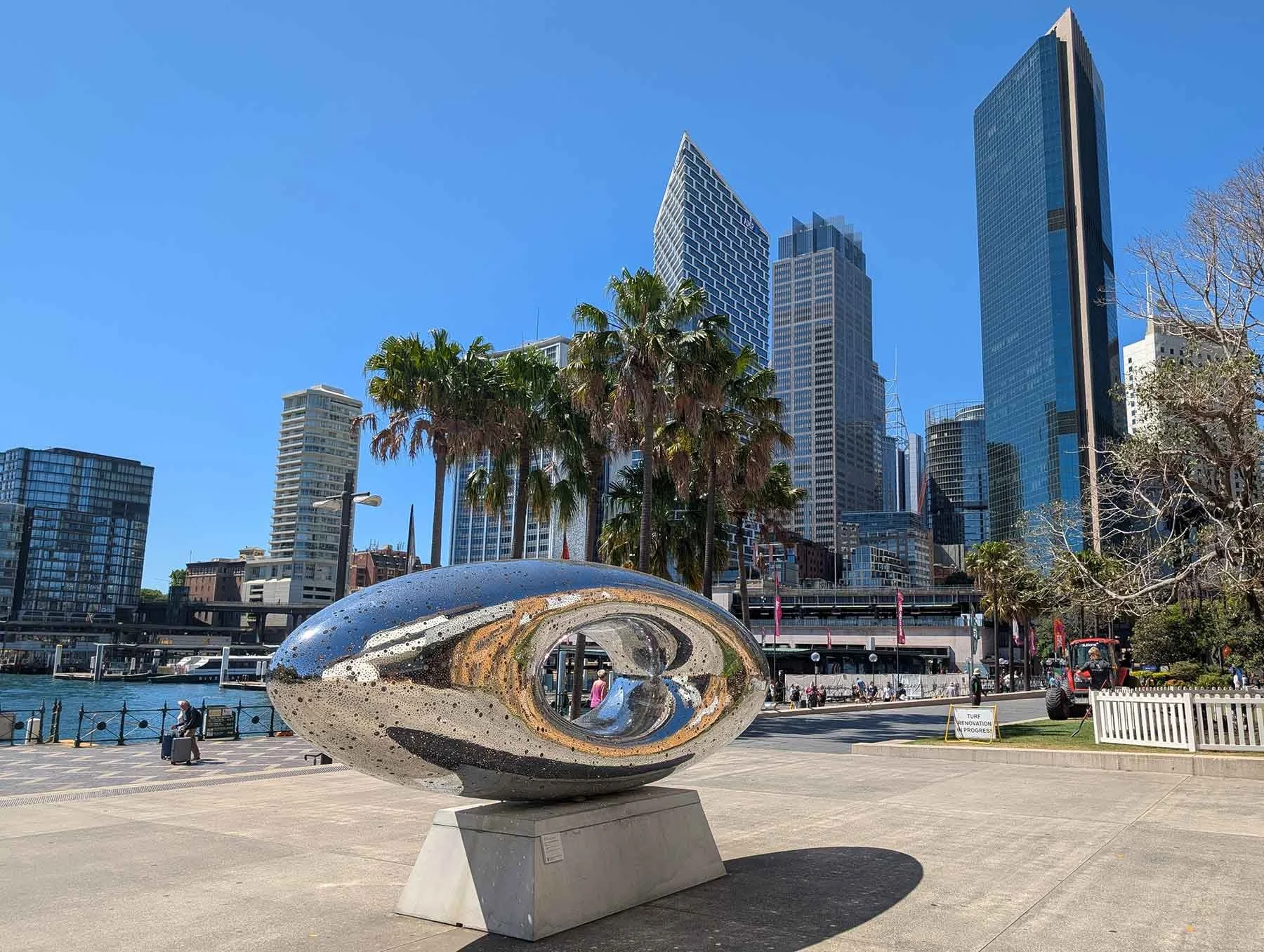
A wide view showing the sculpture against the backdrop of the Sydney CBD. The mirror-polished surface acts as a fish-eye lens, capturing the warm tones of the ground and the cool blues of the skyscrapers
This massive ovoid sits at the edge of Circular Quay, perforated with thousands of holes that turn it into a constellation at night. Lee designed it to explore the connection between human beings and the cosmos.
The fabrication challenge: COVID-19 meant Lee couldn't travel to supervise fabrication in Shanghai.
Her maquette was 3D scanned in Australia. That digital file guided workers on the other side of the world as they torch-cut thousands of perforations by hand. The marine-grade 316 stainless steel was chosen for salt-air resistance. Those perforations aren't just aesthetic—they reduce the wind profile, letting air pass through rather than pushing against the surface.
Forgotten Songs — Michael Thomas Hill (2009)
Location: Angel Place
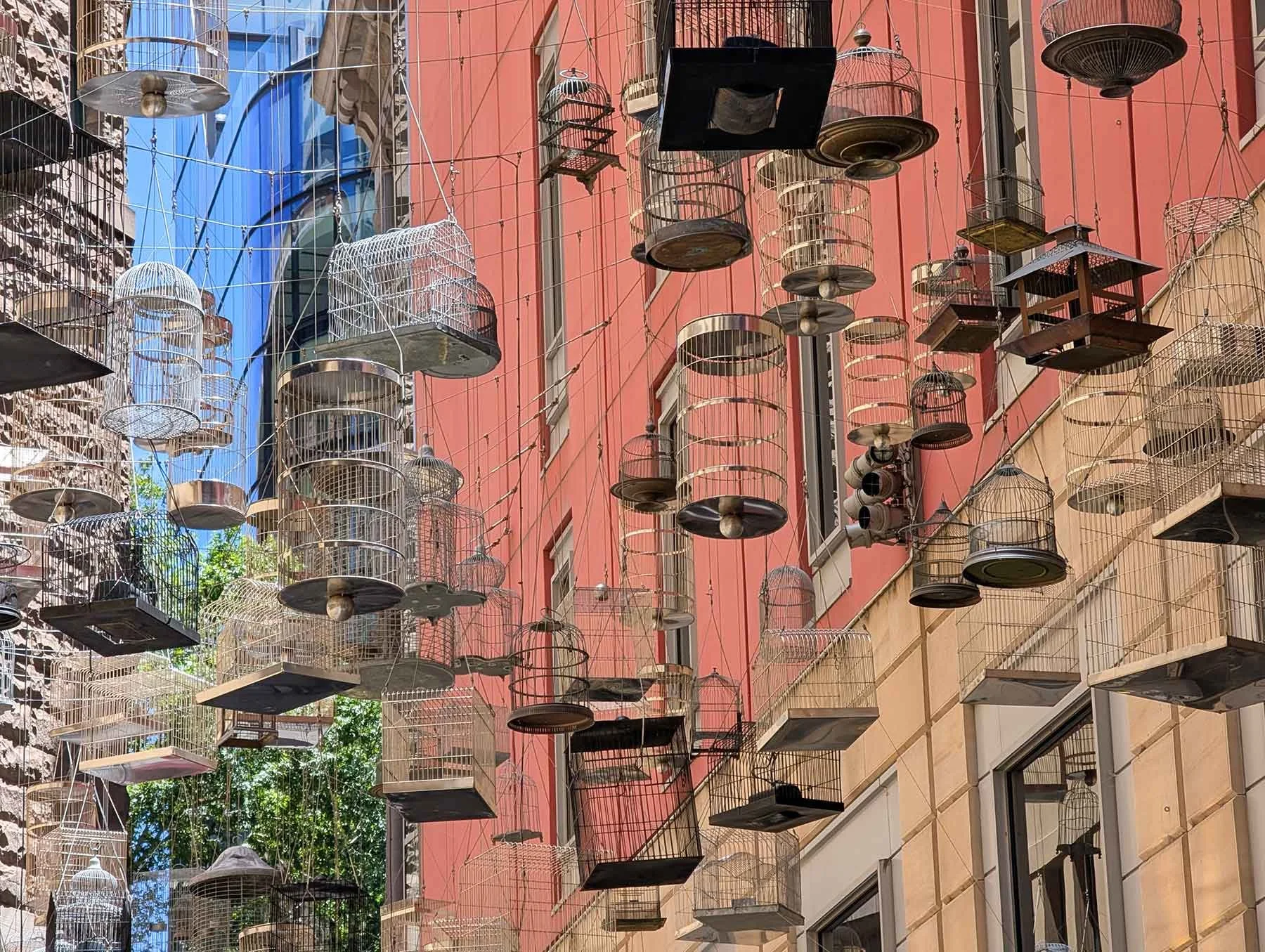
The cages are suspended between two heritage facades in Angel Place. The installation required specialized chemical anchors and pull-testing to ensure the historic brickwork could support the overhead tensile loads of the steel canopy.
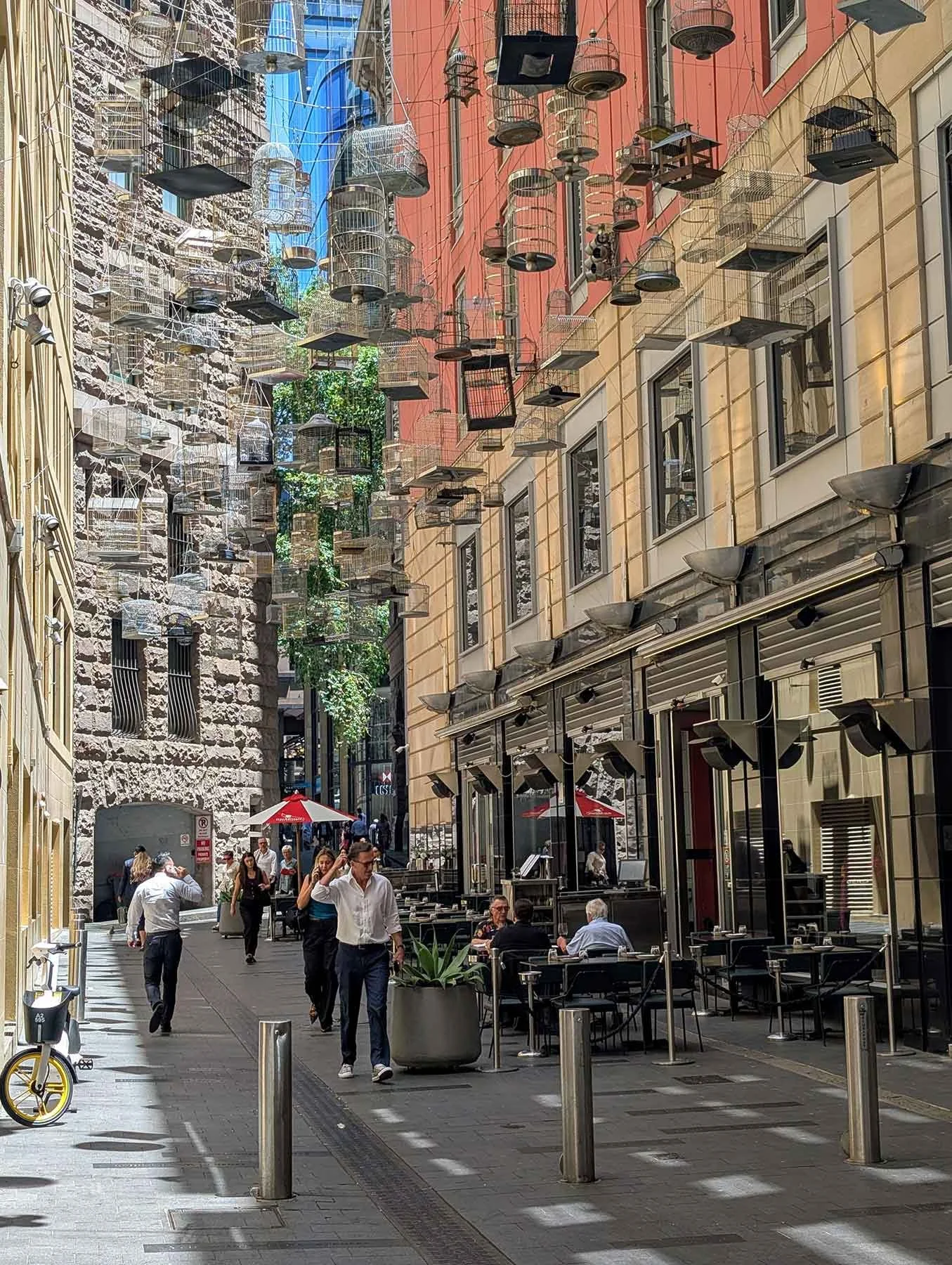
The installation successfully utilizes the "dead space" between buildings. By suspending the artwork high above the ground, the design activates the laneway volume without obstructing the narrow footprint required for pedestrian flow and emergency vehicle access.
Walk down Angel Place and you'll hear them before you see them. Fifty species of birds that once lived in central Sydney, now extinct from the area, singing from 120 suspended cages.
The fabrication challenge: Those cages hang from a tensioned cable system anchored to heritage building facades. The rigging acts as a net designed to handle wind shear in the narrow laneway.
The audio system is programmed to circadian rhythms. Day birds call during daylight hours. Nocturnal species emerge at dusk. Most people don't notice the speakers at all. That invisibility was the point.
Jack Mundey Mural — Vhils (2013)
Location: The Rocks
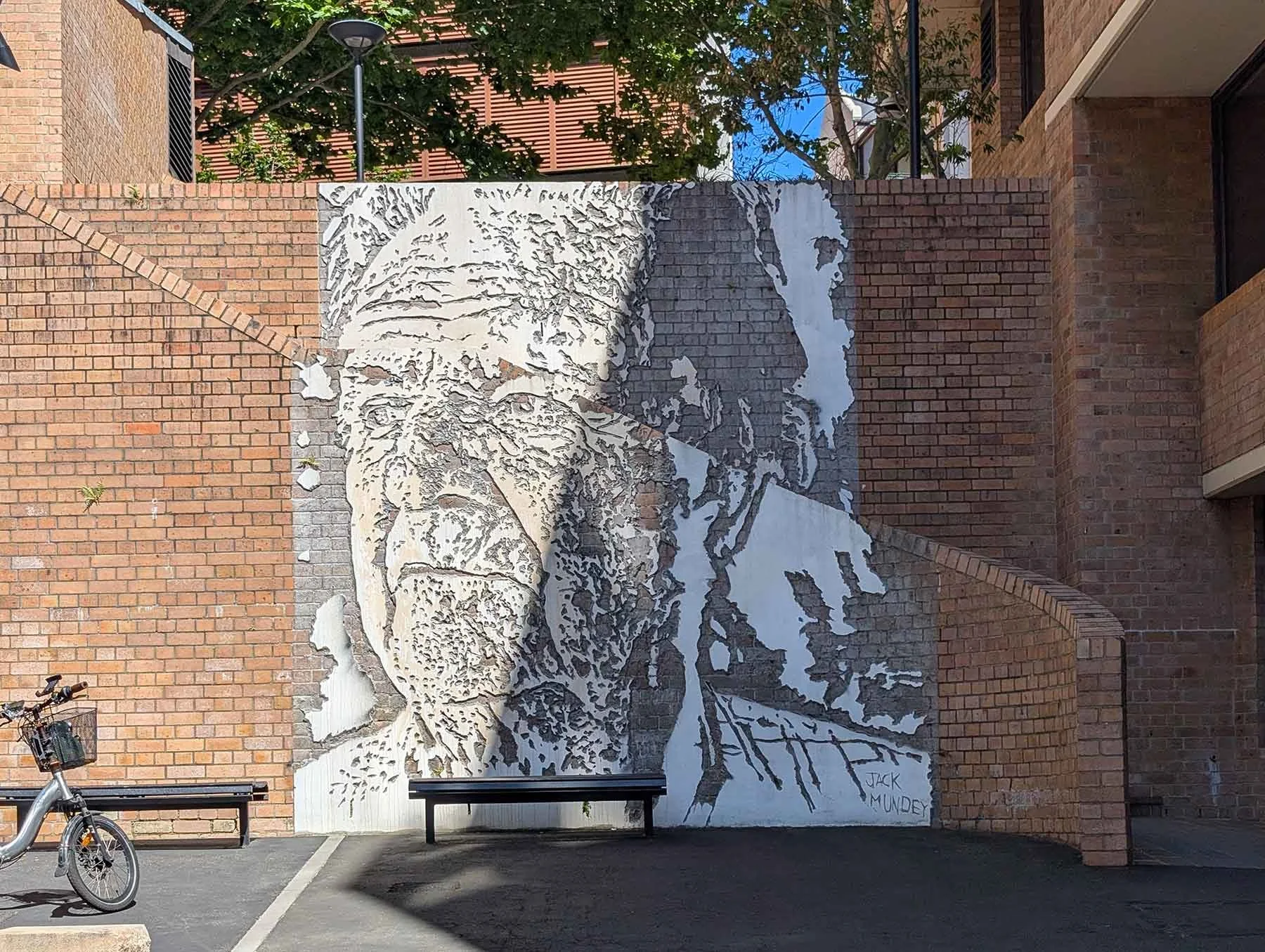
A tribute to Jack Mundey, the leader of the Green Bans who saved The Rocks from demolition. The artwork is physically gouged into the very building fabric he fought to protect, making the medium as significant as the message.
Portuguese artist Vhils carved this portrait of union leader Jack Mundey into a wall in The Rocks. There's a pointed irony here. Mundey's Green Bans saved these heritage buildings from demolition. Now his face is literally embedded in the fabric he protected.
The fabrication challenge: This isn't paint. It's controlled demolition.
Vhils used chisels and jackhammers to remove render and expose the underlying brick. The technique requires an intimate understanding of structural integrity. Remove too much, and the wall crumbles. The artist had to read the building's construction as he worked.
Public Art at the Art Gallery of NSW
The gallery's expansion has brought significant new sculptural commissions to its grounds. The Naala Badu building and Pallion Garden Terrace now host works that challenge both artistic convention and fabrication technique.
Old Man Banks — Guido Maestri (2025)
Location: Pallion Garden Terrace, AGNSW
Fabrication: Bronze cast and finished by Pallion (Palloys); silver Christmas beetles by W.J. Sanders
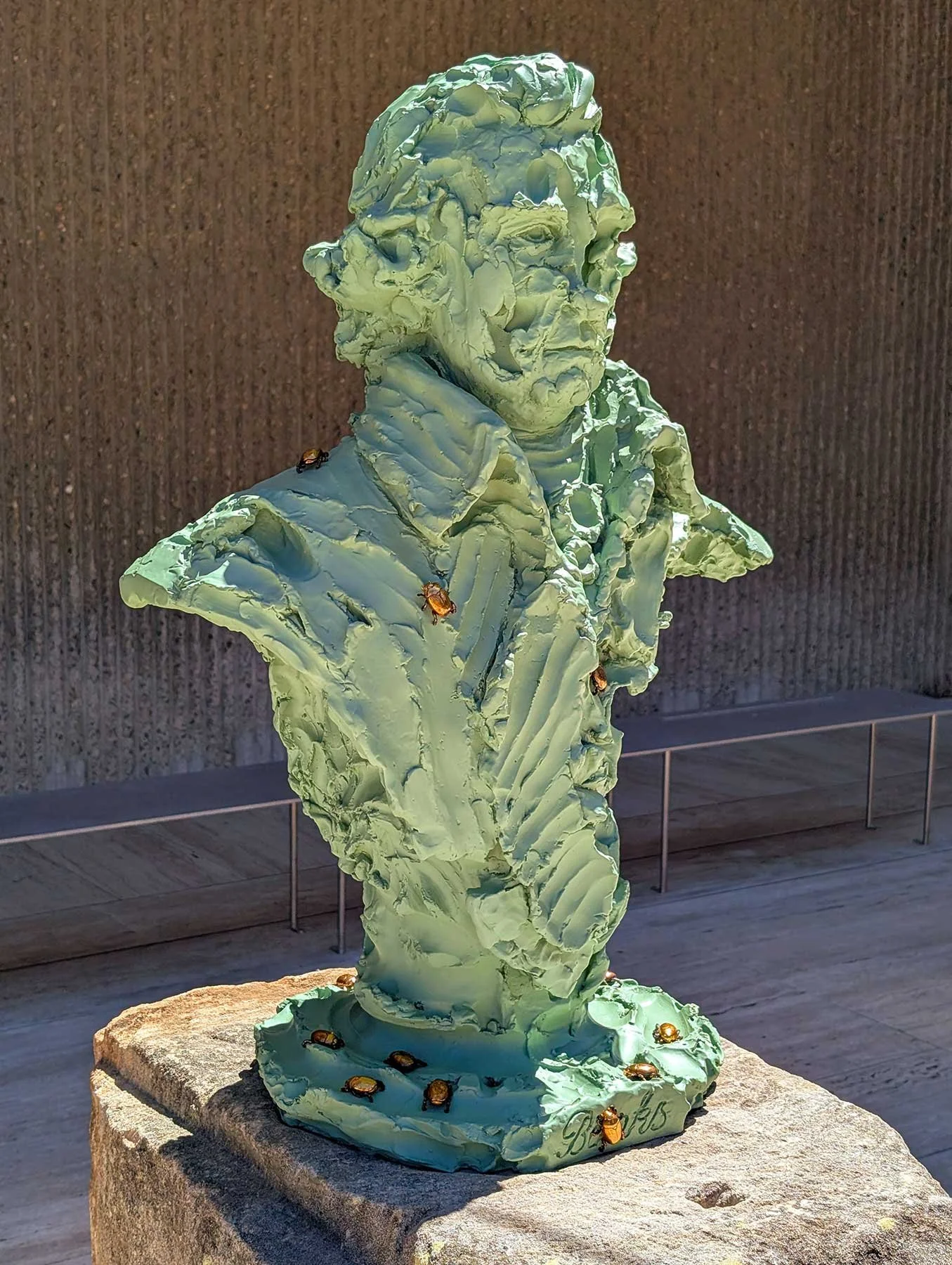
Guido Maestri’s Old Man Banks demonstrates a hierarchy of materials. The bust is cast bronze, sealed in a matte industrial automotive paint to mimic the texture of wet clay. This provides a subdued backdrop for the installation's "jewellery"—handcrafted solid silver Christmas beetles (fabricated by W.J. Sanders) that crawl across the surface
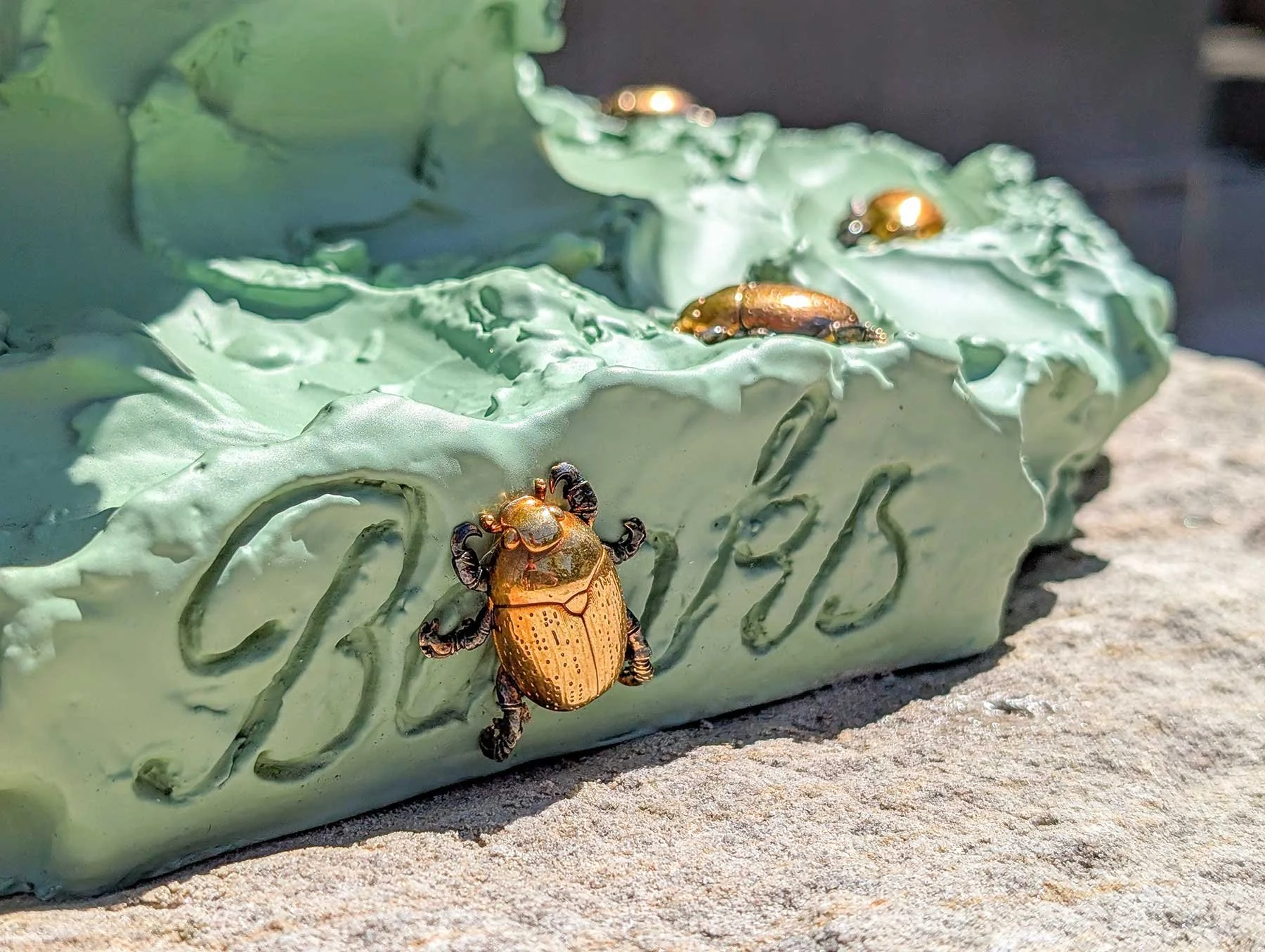
A handcrafted silver Christmas beetle crawls over the inscription on the base of Old Man Banks. A moment of high-polish precision set against the rough, impasto texture of the cast.
Maestri's bronze bust of botanist Joseph Banks doesn't celebrate its subject. It interrogates him. The sculpture sits on the new Pallion Garden Terrace, a bridge between the gallery's old and new buildings—a fitting location for a work that connects colonial history to contemporary critique.
The bust is painted banksia-green, a direct reference to Banksia serrata, one of the species Banks collected during Cook's 1770 voyage. Scattered across the surface are silver Christmas beetles. They're not decoration. They represent endangered species from Banks' own collection—a quiet accusation embedded in the bronze.
The fabrication challenge: The textured surface looks almost geological, as if the figure is eroding or emerging from raw material. Achieving that effect in bronze requires deliberate manipulation of the casting process. The foundry had to preserve every gestural mark from Maestri's original model while ensuring structural integrity.
The beetles presented a different problem. Each one is a separate cast element, attached to the primary bronze. Mixing metals—or even different bronze alloys—risks galvanic corrosion over time. The attachment method and surface treatment had to account for Sydney's coastal air and the AGNSW's exposed terrace location.
The rough-hewn sandstone plinth anchors the work visually, but it's also structural. Bronze at this scale carries significant weight. The stone had to be selected and cut to distribute that load evenly while appearing entirely unconsidered—as if Banks had simply materialised on a harbour rock.
Here Comes Everybody — Francis Upritchard (2022)
Location: AGNSW Naala Badu Building
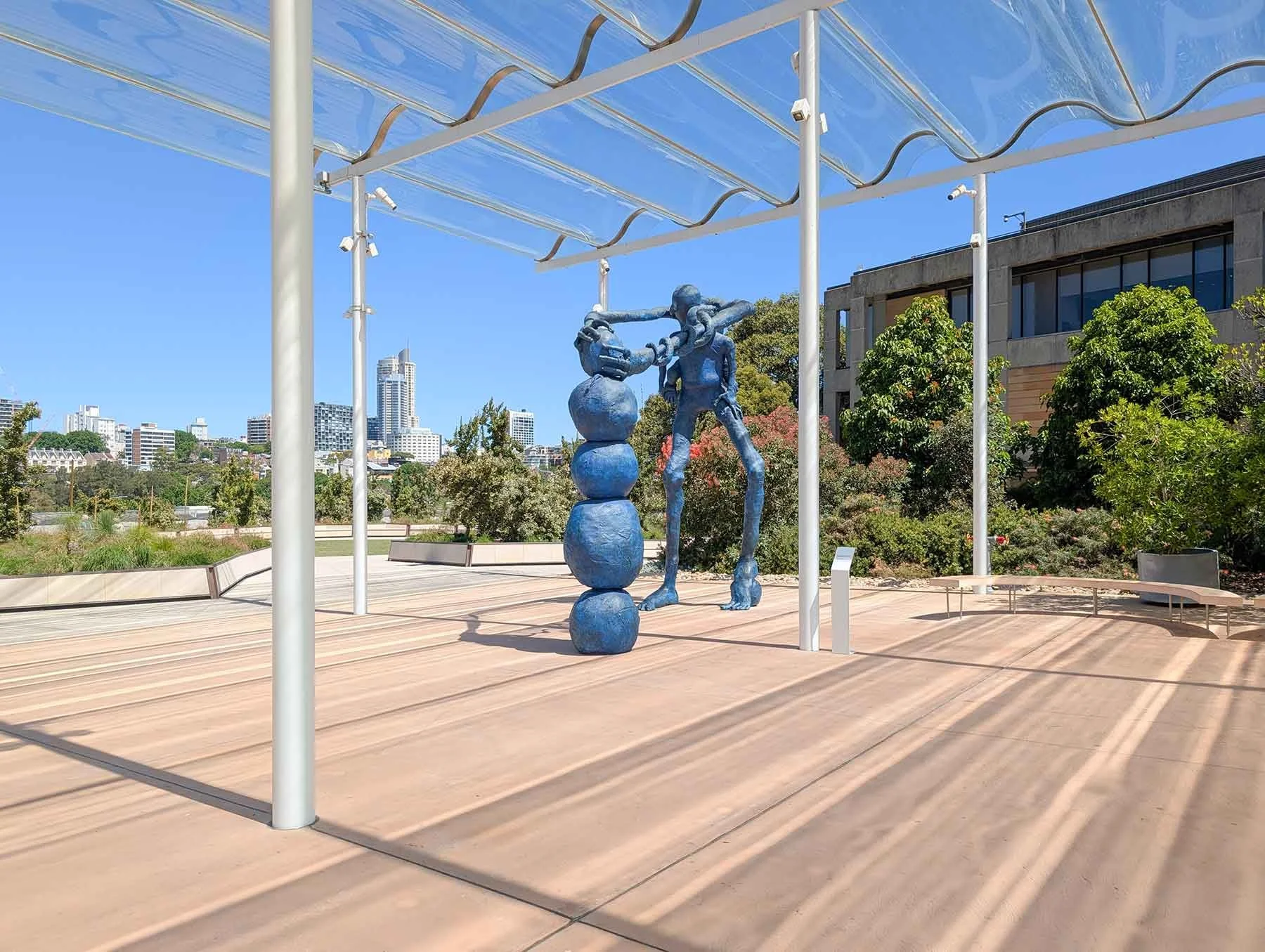
One of Francis Upritchard’s bronze figures standing at the entrance to the new Naala Badu building. The "friendly giants" are positioned to welcome visitors, creating a surreal bridge between the landscaped terrace and the modern architecture of the gallery expansion
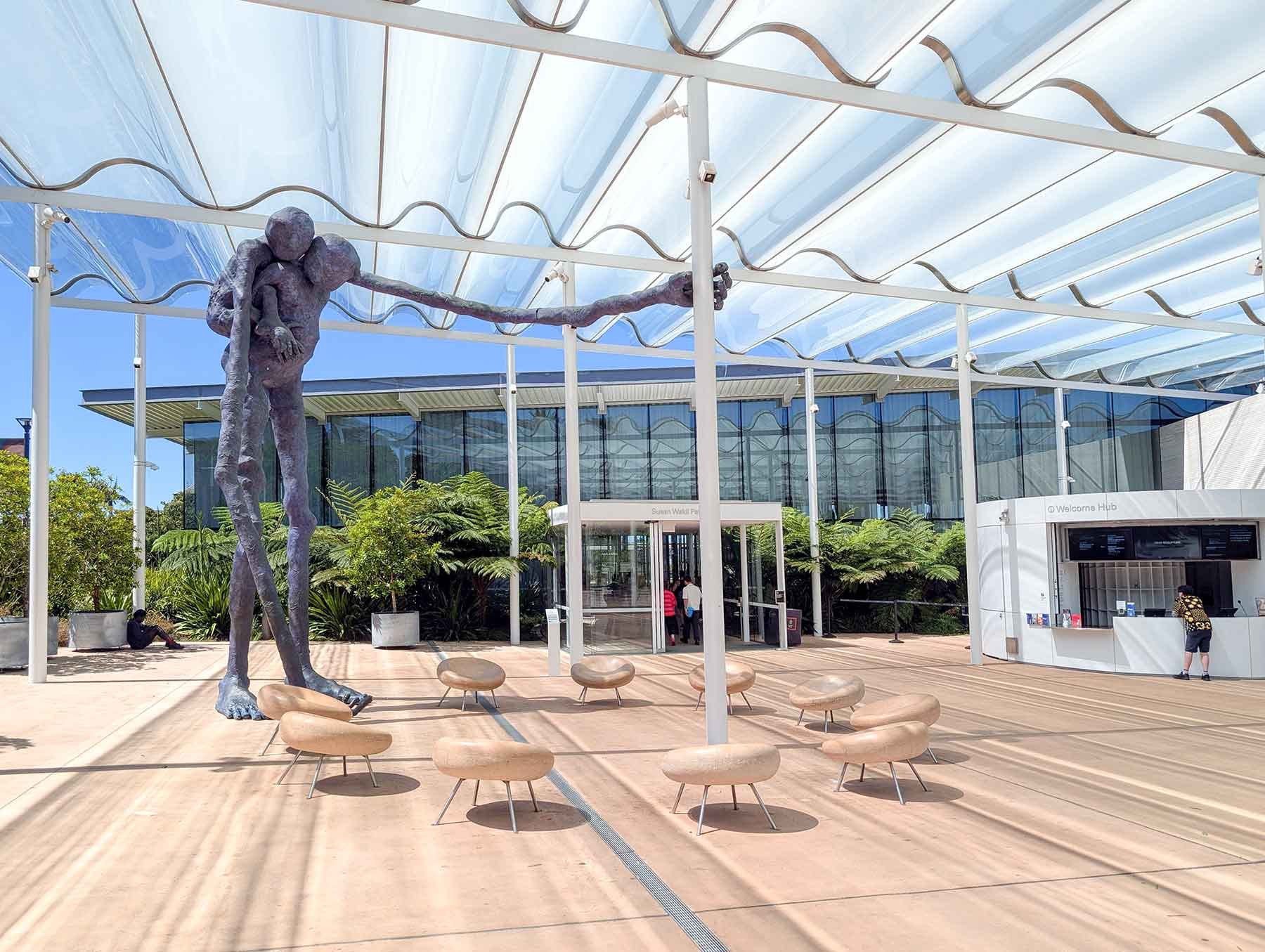
Upritchard’s figures defy standard anatomical proportions. Here, the sculpture physically interacts with the building, reaching out to grasp the canopy column. The fabrication challenge lies in casting such elongated, thin limbs in bronze while maintaining enough structural rigidity to support the figure's height
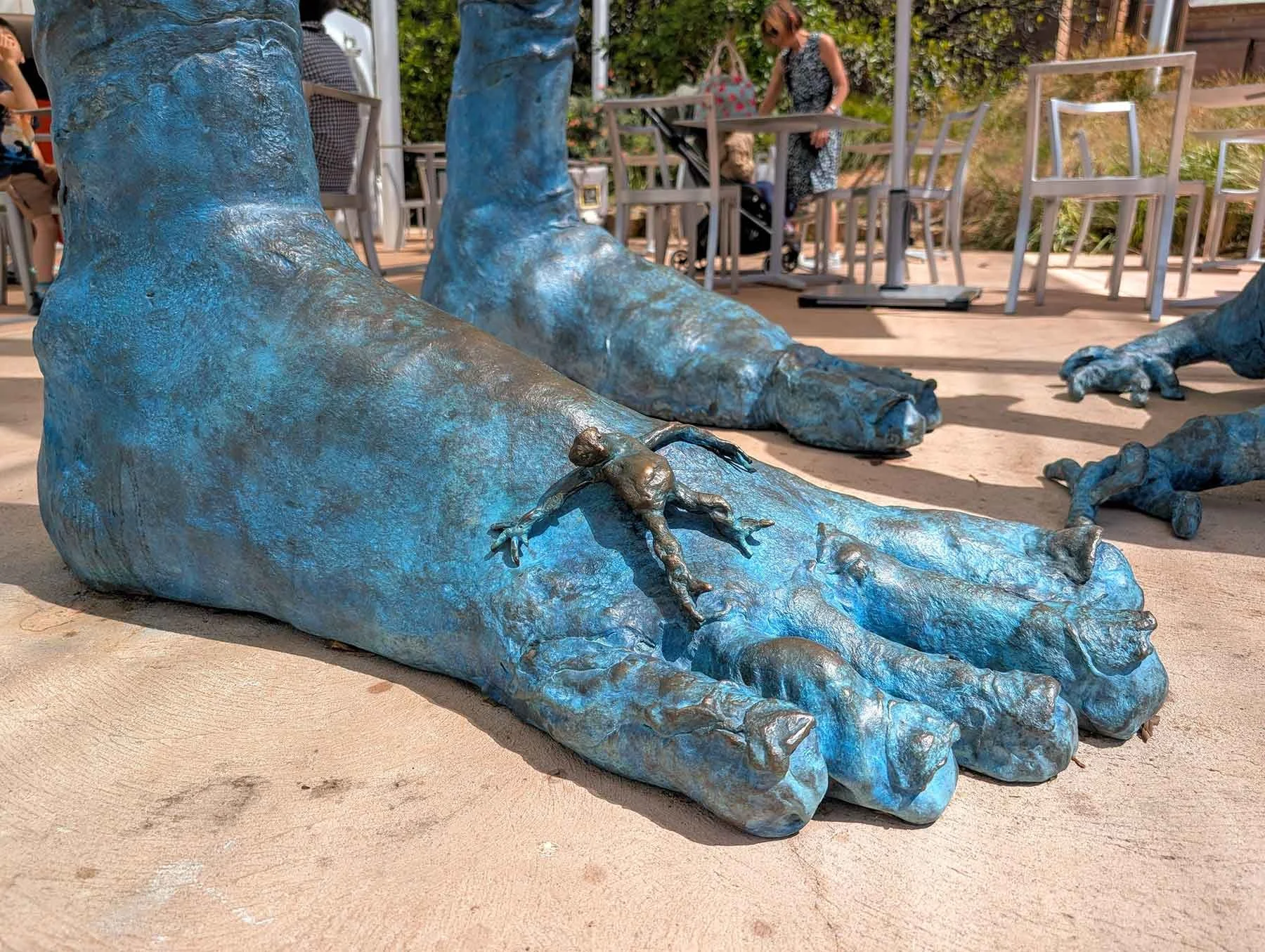
A macro view of the surface texture. The foundry successfully replicated the tactile "squish" of the artist’s original Balata (rubber) models into hard bronze. Note the patina contrast—the chemically applied blue finish against the raw bronze of the small creature—which highlights the casting fidelity.
Upritchard's figures greet visitors like friendly giants. They reference folklore, science fiction, and something harder to pin down—figures that seem ancient and alien at the same time.
The fabrication challenge: The artist modelled the originals in Balata, a natural rubber. Rubber has a specific soft texture that's hard to replicate in metal.
The foundry had to capture that softness in rigid bronze. The patina was chemically applied to give them an appearance of age, as if they'd been standing there for centuries rather than months.
What Makes Public Art in Sydney Different
The challenges here aren't the same as London or New York. Some are cultural. Some are environmental. All of them shape how public art gets made.
First Nations cultural protocols come first. Sydney's CBD sits on Gadigal Country, land of the Gadigal people of the Eora Nation. Public art projects—especially those on significant sites—require consultation with Traditional Custodians through the Metropolitan Local Aboriginal Land Council. The NSW Government's Aboriginal Arts and Cultural Protocols guide how projects should engage with First Nations heritage, knowledge, and storytelling. Some sites carry deep cultural significance that predates European settlement by tens of thousands of years. At Circular Quay, Barangaroo, and the Royal Botanic Gardens, public art increasingly reflects this—not as an afterthought, but as a foundational consideration in how work gets commissioned, designed, and sited.
Then there's the physical environment. Sydney's climate and geography present their own demands.
Salt air accelerates corrosion on anything near the harbour. Material selection matters more than it would ten kilometres inland.
UV exposure is among the highest of any major city. Paint systems and surface treatments have to be industrial grade or they'll fail within years.
Heritage constraints limit what engineers can do. You can't just drill into a sandstone façade or pour concrete on protected ground.
Wind loads in the CBD are unpredictable. Buildings create tunnels and vortices that standard calculations don't capture.
Every sculpture in this guide has been shaped by these conditions—cultural and environmental. That's the work you don't see.
The Future of Public Art in Sydney
The trajectory is clear. We've moved from hand-carved stone to 3D scanning, from slide rules to finite element analysis. The tools change. The fundamental challenge doesn't.
Artists will keep pushing boundaries. They'll propose forms that seem impossible—floating masses, impossibly thin surfaces, materials that shouldn't work together. Someone has to figure out how to build them.
We're Di Emme Creative Solutions. Public art fabrication is our specialty. We work with artists and architects to engineer and build sculptures and installations that survive Sydney's climate, meet council requirements, and hold up under millions of interactions.
View our public art projects
We also deliver architectural metalwork, heritage conservation, and custom fabrication across Sydney. Talk to us about your next project.